
Skip to content

Free worldwide shipping on orders over $1500 — Authenticity guaranteed on every painting

shop now

Cart

Your cart is empty

Article: The Barbizon School in Painting

The Barbizon School in Painting

The Barbizon School in Painting

To view our collection of French 19th-century landscape paintings

Part of our series on the French 19th-Century Landscape School. See also our upcoming guides to Pastoral Scenes, Haystacks in French Painting, and Animated Landscapes with Figures.


Théodore Rousseau, Une avenue, forêt de l'Isle-Adam, 1849, Musée du Louvre, Paris

Théodore Rousseau, Une avenue, forêt de l'Isle-Adam, 1849, Musée du Louvre, Paris. (Wikimedia Commons.)

If Impressionism is the painting of the city's leisure, Barbizon is the painting of the country's work. Where Monet gives you sunlight on a Parisian boulevard or a regatta at Argenteuil, Théodore Rousseau gives you a forest path at dusk, a peasant returning from the fields, a marsh under a low sky. The two movements share a debt to direct observation and a refusal to paint the rehearsed mythologies that the Salon expected. But Barbizon came first, and Barbizon was rural.

That order matters. By the time the young Monet, Renoir, and Pissarro began their own experiments in the 1860s, the Barbizon painters had already spent two decades quietly dismantling the academic landscape tradition. Corot was sixty, painting silvery groves at Ville-d'Avray. Millet was finishing The Gleaners. Rousseau had set up permanently in the village that gave the movement its name. Without Barbizon there is no Impressionism, no Pissarro learning his trade from Corot, no Monet looking at Daubigny's river paintings and thinking he could go further.

And yet the market today still treats Barbizon as a kind of warm-up act. Impressionist canvases command tens of millions at auction while signed, museum-quality Barbizon paintings change hands for a fraction of that. For a collector buying with their eyes rather than their ears, this gap is the most interesting thing in the nineteenth-century landscape market.

This guide is for the collector who wants to understand what they are looking at, why these painters mattered, and where the best opportunities still sit.

What Was the Barbizon School, Really?

The Barbizon School is named for a small village on the western edge of the Forest of Fontainebleau, about an hour south of Paris by train. Beginning in the 1830s, a loose group of painters started spending long stretches there, sometimes living in the inn run by Père Ganne, walking out into the forest each morning with their boxes and panels and oil sketches. They were not a formal academy. They did not issue manifestos. They were a circle of friends who happened to agree on a single radical idea: that you should paint what you actually see, outdoors, from nature, rather than what the Beaux-Arts told you a landscape ought to look like.

The core figures were Théodore Rousseau (1812-1867), Jean-François Millet (1814-1875), Charles-François Daubigny (1817-1878), Narcisse Virgile Diaz de la Peña (1807-1876), Jules Dupré (1811-1889), Constant Troyon (1810-1865), and Charles Jacque (1813-1894). Camille Corot (1796-1875), older than the others, was never strictly part of the village circle, but his work overlapped so completely with theirs that he is always treated as the godfather of the movement.

What they rejected was the historical landscape, the kind of composition where ancient ruins and shepherds in togas stood in for serious subject matter. What they proposed instead was that a stand of oaks in the Fontainebleau forest, or a peasant gleaning in a wheatfield, or a cow drinking from a stream, was worth the same patient attention that academic painters had given to scenes from Ovid and Virgil. The Salon resisted at first. Rousseau was famously rejected so many times in the 1830s and 1840s that he became known as "le grand refusé." By the 1850s and 1860s the tide had turned. By the 1870s Barbizon was being collected aggressively by American industrialists, and the painters were museum names.

How to Spot a Barbizon Painting

The vocabulary is consistent enough that, with practice, you can recognize a Barbizon canvas across a room. The signs to look for:

An earth-based palette. Greens that have been knocked down with brown, grays that lean warm, ochres and raw siennas. The bright cobalt skies and pure greens that you associate with later Impressionism are not here. Barbizon painters wanted truth to the actual color of a French forest or field, which is mostly muted.

A low horizon and a substantial sky. The sky usually takes up half or more of the composition, handled in layered washes that give the painting its atmospheric weight. Barbizon was as much about weather as about land.

Trees as architecture. A single tree, often an oak, often dominating one side of the composition, used to anchor the design and to throw the rest of the scene into a kind of natural perspective. The forest, not the cathedral, is the structural element.

Small figures, integrated. Where figures appear, they are part of the landscape rather than its subject. A shepherd, a gleaner, a woman drawing water, a cattle herd. The figures are usually peasants. They are at work, not at leisure.

Plein air evidence. Many Barbizon paintings, especially the smaller ones, were begun outdoors. Look for the texture of brushwork that suggests rapid execution, for thin paint that lets the ground of the panel show through, for the kind of compositional decisions a painter only makes when standing in front of the actual subject rather than in a studio.

Panel or canvas, intimate scale. The plein air studies tend to be on small wood panels, often less than fifteen inches across. The finished, salon-scale paintings are on canvas. Both have their collectors.

No togas, no temples, no allegorical figures. If a painting has all of the above and any of those, it is not Barbizon.

The Great Barbizon Painters

Camille Corot (1796-1875)

Camille Corot, Souvenir de Mortefontaine, 1864, Musée du Louvre, Paris

Camille Corot, Souvenir de Mortefontaine, 1864, Musée du Louvre, Paris. (Wikimedia Commons.)

Corot is the figure who makes the whole movement intelligible. He had been painting plein air landscapes in Italy and around Paris since the 1820s, two decades before Rousseau settled at Barbizon. His method was to paint small, fast, truthful studies outdoors, then work the larger salon paintings up in the studio from those studies. The Souvenir de Mortefontaine, painted in 1864 and now at the Louvre, is the most famous example of his late, silvery manner. A woman gathering branches on the left, two children at the base of a tree on the right, a still lake reflecting an evening sky. The whole composition is held together by light that seems to come from nowhere in particular.

Corot's influence on every painter who followed, Barbizon and Impressionist alike, is incalculable. Pissarro called himself Corot's student. Berthe Morisot studied with him. Monet borrowed his use of soft tonal transitions. For collectors, signed Corot landscapes are now firmly in the museum range, but his immediate followers (and there were many) still come to market regularly at accessible prices.

Théodore Rousseau (1812-1867)

Rousseau is the leader of the village circle. He moved permanently to Barbizon in 1847 and stayed there until his death. His best paintings, like the Une avenue, forêt de l'Isle-Adam at the Louvre (shown at the top of this article), have a density and a structural confidence that the others rarely match. The forest is built up trunk by trunk, branch by branch, in oil layers that took months to finish. Rousseau was a painter of obstinate truthfulness. Where Corot smoothed and softened, Rousseau insisted on the gnarl of the oak and the weight of the cloud bank.

The Salon refused him repeatedly for over a decade. When his work was finally accepted, the recognition came late and was qualified. He died at fifty-four, exhausted, with much of his best work in private hands. The Louvre, the Musée d'Orsay, the Metropolitan Museum in New York, and the Walters in Baltimore all hold major Rousseau paintings. He is the painter most often cited by other painters as their model.

Jean-François Millet (1814-1875)

Jean-François Millet, The Gleaners (Des glaneuses), 1857, Musée d'Orsay, Paris

Jean-François Millet, The Gleaners (Des glaneuses), 1857, Musée d'Orsay, Paris. (Wikimedia Commons.)

Millet pushed Barbizon further toward the peasant subject than any of the others. The Gleaners, painted in 1857 and now at the Musée d'Orsay, is the central image of the entire movement. Three women bend in a stubble field at the end of harvest, gathering the wheat the reapers have left behind. The light is the warm low light of late afternoon. The figures have the dignity that history painters reserved for kings and saints, applied here to the poorest agricultural workers in rural France. The painting was politically inflammatory in 1857. It is now uncontroversially one of the most reproduced images in nineteenth-century art.

Millet's pastel and oil studies for figures, harvest scenes, and shepherds with their flocks remain widely collected. He is the Barbizon painter whose work feeds most directly into the iconography that GalerieClub specializes in: the pastoral scene with sheep, the peasant at work in the field, the shepherd against a low horizon.

Charles-François Daubigny (1817-1878)

Charles-François Daubigny, Banks of the Oise at Auvers, Saint Louis Art Museum

Charles-François Daubigny, Banks of the Oise at Auvers, Saint Louis Art Museum. (Wikimedia Commons.)

Daubigny was the river painter of the group. He built a studio boat called Le Botin and floated down the Oise and the Seine, painting from the deck. His handling of water (loose, transparent, full of broken reflected light) is the most clearly proto-Impressionist work that any Barbizon painter produced. Monet later did exactly the same thing, on his own studio boat at Argenteuil, painting Daubigny's subjects in Daubigny's manner.

Daubigny's late paintings of the Oise around Auvers (the village where Van Gogh would later die) are some of the most beautiful river landscapes in nineteenth-century French art. They are also still relatively available on the market, in a price range that signed Monets have not occupied in over a century.

Constant Troyon (1810-1865)

Constant Troyon, Cattle Drinking, Walters Art Museum, Baltimore

Constant Troyon, Cattle Drinking, Walters Art Museum, Baltimore. (Wikimedia Commons.)

Troyon is the Barbizon painter of cattle. His large salon canvases of cows and sheep moving through morning mist or watering at the edge of a pond were enormous commercial successes in his own lifetime. The Walters in Baltimore, the Wallace Collection in London, the Hermitage, and the Met all hold major examples. His handling is broad, his palettes are warm, and his animals are observed with the kind of patient attention that only a painter who actually spent time in barns and fields could produce.

Troyon's influence on the next generation of pastoral painters was immense. Anyone painting cattle and sheep in nineteenth-century France was painting in his shadow. He died at fifty-five, at the height of his market, and the auction record for his work shows decades of steady demand from American collectors who built their Gilded Age galleries around him.

Narcisse Virgile Diaz de la Peña (1807-1876)

Narcisse Virgile Diaz de la Peña, Forest of Fontainebleau, Reading Public Museum

Narcisse Virgile Diaz de la Peña, Forest of Fontainebleau, Reading Public Museum. (Wikimedia Commons.)

Diaz was the forest painter. Where Rousseau gave you the structural oak, Diaz gave you the dappled clearing, the light breaking through the canopy onto a patch of moss and a half-glimpsed nymph. His work has a romantic, almost Renaissance quality that the more austere Rousseau never courted. He was wildly popular in the 1850s and 1860s, less so today, which is exactly the configuration that creates buying opportunities for collectors who trust their own eyes over the auction averages.

Jules Dupré (1811-1889)

Jules Dupré, Landscape with Cows

Jules Dupré, Landscape with Cows. (Wikimedia Commons.)

Dupré is the most romantic of the core group, painting storm-lit skies, twisted oaks, and cattle moving against weather. His work overlaps with Troyon's in subject and with Rousseau's in compositional density. He outlived most of the other Barbizon painters, dying in 1889, by which time the Impressionists had taken over the market for French landscape. Dupré's auction prices today reflect that historical eclipse, and his finest paintings remain accessible at prices that do not match their art-historical importance.

Why Collectors Should Be Paying Attention

Three things make the Barbizon market interesting right now.

The first is the price gap. A signed, authenticated, museum-quality Barbizon canvas typically trades for a fraction of a comparable Impressionist work by a less important painter. A Daubigny river scene at auction will go for what a workshop-quality Renoir flower piece costs. The art-historical weight is on Daubigny's side. The market has not caught up.

The second is the inventory. Because Barbizon was overproduced during the late nineteenth century (the second wave of painters absorbing the lessons of the founders), there is a deep stock of accomplished, attractive paintings still circulating in French and European private collections. A patient collector can build a small but serious Barbizon group over a few years at prices that have nowhere near peaked. The kind of group that, fifty years ago, an American industrialist might have assembled in a season.

The third is the durability. These are not paintings about fashion. They are paintings about land, weather, work, and light. They have weathered Impressionism, weathered modernism, weathered the rise and fall of every subsequent movement, and they still read clearly to anyone who walks into a room hung with them. Auction prices have remained steady. Museum interest has been quietly growing for the past decade. Any documented Barbizon canvas of quality is now an investment of substance.

From Our Collection

We currently hold six period paintings in the Barbizon and Barbizon-descended tradition, ranging from a signed, listed Impressionist work by Adolphe Felix Cals (Musée d'Orsay) to a small dated panel by Eugene Forest in classic Barbizon manner. Each is a period work, sourced from private European collections, presented with full provenance.

Adolphe Felix Cals, Haystacks Landscape, signed oil on canvas, available at GalerieClub Fine Art

Adolphe Felix Cals (1810-1880), Haystacks Landscape. Signed oil on canvas, 7 x 13 inches.

Cals is the Barbizon-Impressionist bridge in our collection. He participated in the first Impressionist exhibition of 1874 alongside Monet, Renoir, and Pissarro, and his work is held at the Musée d'Orsay and the Musée des Beaux-Arts de Rouen. This small canvas, signed "Cals," shows two haystacks under a low Normandy sky, painted in the warm earth palette and broken brushwork that connect his work directly to the Barbizon tradition while pointing forward to what Monet would later do with the same subject. Sourced from a private European collection.

View this painting

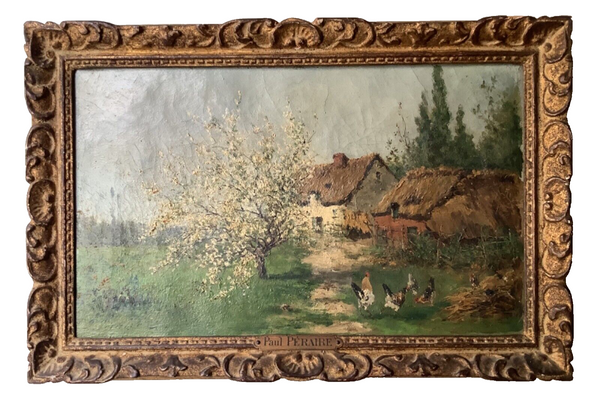
Paul Emmanuel Peraire, Farm Landscape in Spring, signed oil on canvas, available at GalerieClub Fine Art

Paul Emmanuel Peraire (1829-1893), Farm Landscape in Spring. Signed oil on canvas, 10 x 16 inches.

Peraire is another painter who carried the Barbizon tradition into the Impressionist generation. His landscapes are held in the Musée d'Orsay and the Musée des Beaux-Arts de Bordeaux. This canvas shows a French farm in early spring, the trees just coming into leaf, painted in the bright, fresh manner that Barbizon-influenced Impressionists like Pissarro were perfecting in the same years. The reverse bears a Paris American Art gallery stamp (inventory #8057), evidence of the American collecting market for second-generation Barbizon work in the late nineteenth century.

View this painting

Charles Edmond Renault, Women by the River in an Animated Landscape, Barbizon School oil on canvas, available at GalerieClub Fine Art

Charles Edmond Renault (1829-1905), Women by the River in an Animated Landscape. Signed oil on canvas, 9 x 14 inches.

A fully developed Barbizon-tradition canvas with the signature compositional formula of the school: tall trees anchoring the left, a river opening out to the right, two small figures placed for scale, a town indicated in the misty distance. The diffused silvery light is exactly the quality the Barbizon painters spent careers chasing. Presented in a substantial period gilt frame with carved foliate scrollwork at the corners.

View this painting

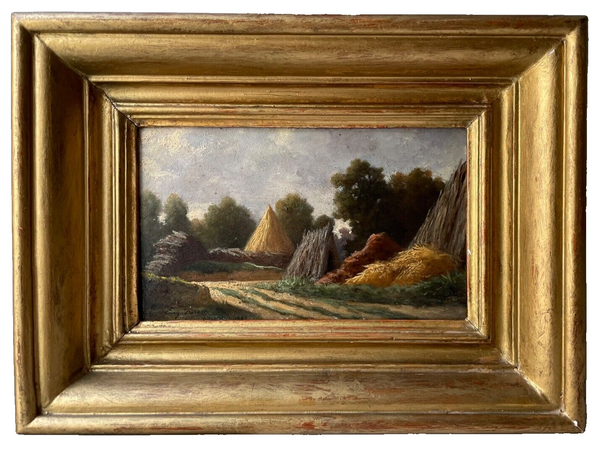
Eugene Forest, Haystacks Landscape 1882, signed Barbizon School oil on wood panel, available at GalerieClub Fine Art

Eugene Forest (1808-1891), Haystacks Landscape 1882. Signed and dated oil on wood panel, 5 x 9 inches.

A small, dated plein-air panel by a Benezit-listed Barbizon painter, painted late in his life (Forest was 74 in 1882). The format is exactly what the Barbizon plein-air method produced: a wood panel small enough to be carried into the field, built up in confident strokes that read as direct observation rather than studio finish. The palette is the disciplined Barbizon range of ochre, raw sienna, muted green-gray, and cool sky tone. The kind of painting a collector buys to hold in the hand as much as to hang on the wall.

View this painting

Gaston Bonfils, Haystacks in a French Harvest Landscape, signed oil on panel, available at GalerieClub Fine Art

Gaston Bonfils (1855-1946), Haystacks in a French Harvest Landscape. Signed oil on wood panel, 9 x 13 inches.

Bonfils worked in the late Barbizon tradition with a strong overlay of Impressionist palette knife work. Five or six haystacks in conical form across a stubble field, a line of trees on the horizon, the warm gold of late summer. The paint surface is built up with palette knife in places, giving the haystacks an almost sculptural weight that distinguishes Bonfils from the smoother handling of his Barbizon predecessors. Signed "G. Bonfils" lower right.

View this painting

Antique Barbizon School oil painting, Lively Landscape with Figures by a River, available at GalerieClub Fine Art

School of Barbizon, second half 19th century. Oil on wood panel, 10 x 14 inches.

An unsigned but clearly Barbizon-trained landscape with the full vocabulary of the school: tall trees on the left, a river opening to the right, two small figures and grazing cattle in the foreground, a town suggested along the distant bank, and the characteristic diffused silvery light that reads as the Île-de-France countryside. The composition shows a clear debt to Corot and his immediate followers. Presented in a period gilded carved frame with scrollwork.

View this painting


Browse all our French 19th-century landscape paintings

A reminder for our American customers: no federal tariffs on original paintings imported into the United States. Free fine-art shipping to the US and Canada. Authenticity guaranteed on every painting.

Key Paintings to See in American and European Museums

Théodore Rousseau, Une avenue, forêt de l'Isle-Adam, 1849. Musée du Louvre, Paris.
Théodore Rousseau, The Forest in Winter at Sunset, c. 1846-67. Metropolitan Museum of Art, New York.
Jean-François Millet, The Gleaners (Des glaneuses), 1857. Musée d'Orsay, Paris.
Jean-François Millet, The Angelus, 1857-59. Musée d'Orsay, Paris.
Camille Corot, Souvenir de Mortefontaine, 1864. Musée du Louvre, Paris.
Camille Corot, Ville-d'Avray, c. 1865. National Gallery of Art, Washington DC.
Charles-François Daubigny, Banks of the Oise at Auvers. Saint Louis Art Museum.
Constant Troyon, Cattle Drinking. Walters Art Museum, Baltimore.
Constant Troyon, Oxen Going to Plough, 1855. Hermitage Museum, Saint Petersburg.
Narcisse Virgile Diaz de la Peña, Forest of Fontainebleau. Reading Public Museum, Pennsylvania.
Jules Dupré, Landscape with Cows. Multiple US and European public collections.
Charles Jacque, Sheep at Pasture. Walters Art Museum, Baltimore; Musée d'Orsay, Paris.

Read More in This Series

This is the pillar article of our new cluster on the French 19th-Century Landscape School. The next guides will go deeper into specific Barbizon subjects, with their own iconographic vocabularies and their own pockets of in-stock works.

Coming next: Pastoral Scenes, Shepherds and Sheep in 19th-Century French Painting. Haystacks in French Painting, Before and After Monet. Animated Landscapes, Figures in 19th-Century French Painting. French Impressionist Landscape Painting Beyond the Famous Names.

To view our collection of French 19th-century landscape paintings

Read more

Salome and the Head of John the Baptist in Painting
Baroque

Salome and the Head of John the Baptist in Painting

To view our collection on Salome and Saint John the Baptist Part of our series on the Women of the Gospels in Painting. See also our guides to Mary Magdalene, the Samaritan Woman at the Well, and J...

Read more
Pastoral Scenes - Shepherds and Sheep in 19th-Century French Painting
Barbizon

Pastoral Scenes - Shepherds and Sheep in 19th-Century French Painting

To view our collection of French pastoral paintings Part of our series on the French 19th-Century Landscape School. See also our pillar guide to The Barbizon School in Painting. Jean-François Mil...

Read more