
Collecting 18th-Century French Portraits
To view our collection of 18th-century paintings
Part of our series on collecting French portraiture in our Collecting Guides.
_-_Louvre_Museum.jpg?width=900)
Hyacinthe Rigaud, Louis XIV in Coronation Robes, 1701. Musee du Louvre, Paris. Image: Wikimedia Commons, public domain.
In 1701, Louis XIV stood for the most famous portrait ever painted of a French king. Hyacinthe Rigaud showed him in his coronation robes, ermine thrown back to reveal a dancer's legs, the crown resting beside him. The painting was meant as a gift for his grandson, the new King of Spain. Louis liked it so much he kept it. For the next ninety years, until the Revolution swept the whole system away, French portrait painting followed the standard this picture set: likeness in the service of status, fabric painted as carefully as faces, and a studio system that produced portraits by the thousands.
That last point matters more to a collector than any other. Because the great portraitists of the 18th century ran busy workshops, and because their manner was imitated across France and Europe, original period portraits from their circles and followers survive in real numbers. The famous names hang in the Louvre and Versailles. The world they created, the same poses, the same lace, the same silvery light on silk, can still be bought, and often for less than a minor Impressionist sketch. This guide explains who the masters were, how attribution language actually works, and how to read a portrait's wigs, dress and format like a specialist.
The Portrait Century
The Academie royale de peinture et de sculpture, founded in 1648, ranked the genres of painting. History painting stood at the top, portraiture just below it, well above landscape and still life. In practice, portraiture was where the money was. Everyone who mattered in French society needed to be painted: the royal family for reasons of state, the nobility to prove lineage, and, as the century went on, bankers, magistrates, actresses and philosophers to prove they had arrived.
A portrait was not simply a likeness. It was a legal and social document. The sitter's dress, wig, jewels and setting were chosen to communicate rank as precisely as a uniform. This is why 18th-century French portraits reward slow looking: every detail was put there to say something, and most of it can still be read today.
The Masters and Their World
Hyacinthe Rigaud: The State Portrait
Rigaud (1659-1743) arrived in Paris from Perpignan and became the official face of the Bourbon monarchy. His formula, a three-quarter view, a column or drapery behind, dark background, dazzling attention to velvet and lace, was repeated by his large workshop for princes, marshals and bishops across Europe. Demand was so high that Rigaud kept careful account books recording which portraits were fully by his hand and which were workshop productions he supervised and finished.
That workshop culture is exactly why collectors today can still own a piece of this world. Portraits from Rigaud's orbit, painted by studio assistants, pupils and independent painters working in his manner, carried the court style far beyond Versailles.
From our collection: Antique French Baroque Royal Portrait, After Hyacinthe Rigaud, 18th Century
A young man in a long powdered wig and a red velvet cloak over a white lace cravat, painted in the formal court style of the early 1700s. The frontal pose, the dark neutral background and the soft light modeling the face all follow the Rigaud formula. Historical records associated with the painting identify the sitter as Louis de France, a title carried by several Bourbon princes of the period. A gilt frame completes the presentation.
Jean-Marc Nattier: Goddesses at Versailles
Nattier (1685-1766) made his name with the portrait historie, the portrait in mythological disguise. He painted the daughters of Louis XV and the ladies of the court as Diana, Hebe or Flora, wrapped in blue silk and morning light. The flattery was transparent and nobody minded. Under the costume, Nattier was a superb painter of skin, pearls and satin, and his softer, silvery palette defined the look of the mid-century.

Jean-Marc Nattier, Madame de La Porte, 1754. Art Gallery of New South Wales. Image: Wikimedia Commons, public domain.

Jean-Marc Nattier, Madame Le Fevre de Caumartin as Hebe, 1753. National Gallery of Art, Washington. Image: Wikimedia Commons, public domain.
Louis Tocqué: The Honest Likeness
Louis Tocqué (1696-1772) trained in Nattier's circle and married his daughter, but his art went the other way. Where Nattier flattered, Tocqué observed. Elected to the Academie royale in 1734, he became the favorite of sitters who wanted truth with their dignity: his 1740 state portrait of Queen Marie Leszczynska, now in the Louvre, shows a plain, intelligent, kind face above the full weight of the coronation mantle. The Russian and Danish courts both summoned him abroad, a rare honor for a French portraitist.

Louis Tocqué, Marie Leszczynska, Queen of France, 1740. Musee du Louvre, Paris. Image: Wikimedia Commons, public domain.
Tocqué's restrained manner, neutral backgrounds, quiet poses, extraordinary care over lace and skin, was widely adopted by painters in his circle and by followers through the second half of the century. Portraits in his manner are among the most satisfying 18th-century paintings a private collector can live with, precisely because they are calm.
From our collection: Follower of Louis Tocqué, Portrait of a Gentleman with Lace Jabot
A man in a dark blue coat meets the viewer with a calm, direct gaze. His powdered wig is curled at the sides in the fashion of mid-18th century France, a white lace jabot falls over his chest, and a small red flower is pinned to his lapel. The plain warm brown background is pure Tocqué: nothing distracts from the face and the fabrics. Oil on canvas in a gilt wood frame.
From our collection: Follower of Louis Tocqué, Portrait of a Woman with Pearl Necklace
The companion image of the same refined world: a woman with a pearl necklace and a rose, painted with the smooth modeling and quiet palette of the Tocqué circle. Together with the gentleman above, the pair shows how mid-century portraiture balanced individual likeness with a shared code of elegance. Oil on canvas in a gilt frame.
Joseph-Siffred Duplessis: The Last King
By the 1770s the official portrait had a new master. Joseph-Siffred Duplessis (1725-1802) painted Louis XVI in his coronation robes around 1777, an image copied endlessly for embassies, town halls and loyal households across the kingdom. Duplessis also painted Benjamin Franklin during his Paris years, producing the face that still looks out from the hundred dollar bill. His royal portraits are the final statement of the tradition Rigaud began: within fifteen years, the man in the ermine would go to the guillotine.

Joseph-Siffred Duplessis, Louis XVI in Coronation Robes. Musee Ingres-Bourdelle, Montauban. Image: Wikimedia Commons, public domain.
From our collection: French Oil Portrait of Louis XVI, 18th Century
An original 18th-century oil portrait of Louis XVI, painted during the period when images of the king circulated throughout France as marks of office and loyalty. Portraits like this one were the way most French subjects ever saw their monarch's face. Owning one today means owning a period document of the last reign of the Ancien Regime.
Élisabeth Vigée Le Brun: The Final Flowering
The most famous French portraitist of the 1780s was a woman. Élisabeth Vigée Le Brun (1755-1842) became Marie Antoinette's preferred painter and a member of the Academie royale in 1783, the same year her portrait of the queen in a simple muslin dress caused a scandal at the Salon. Her replacement picture, Marie Antoinette with a Rose, kept the pose but restored the silk. Vigée Le Brun's warmth and naturalness pointed to where portraiture was heading, but the Revolution arrived first. She spent it in exile, painting the aristocracy of Italy and Russia instead.

Élisabeth Vigée Le Brun, Marie Antoinette with a Rose, 1783. Palace of Versailles. Image: Wikimedia Commons, public domain.
Understanding Attribution: What the Words Actually Mean
Nothing confuses new collectors of Old Master paintings more than attribution language, and nothing matters more to value. The vocabulary is standardized and worth learning by heart. From strongest to weakest connection with the named artist:
Signed / By the artist: the work is by the named painter. In the 18th century many portraits were not signed, so attribution often rests on documents, style and quality rather than a signature.
Attributed to: probably by the artist, in the opinion of specialists, but without certainty.
Studio of / Workshop of: painted in the artist's workshop, possibly with his participation or under his supervision. Given how Rigaud, Nattier and their peers actually worked, studio pictures are period originals produced feet away from the master.
Circle of: a work of the period, by a painter closely connected to the artist, though not necessarily a pupil.
Follower of: a painter working in the artist's style, during his lifetime or somewhat later. Not an imitation in the negative sense: followers were often accomplished professionals serving clients who wanted the fashionable court look.
Manner of: in the artist's style but at a later date.
After: a copy of a known composition by the artist. Period copies of royal portraits were an industry in themselves, officially encouraged, since every institution in France needed the king's image.
Here is the practical point. An autograph Rigaud or Nattier now belongs in museum territory. But circle, follower and studio works are genuine 18th-century paintings, made with the same materials, for the same clientele, breathing the same air. They are the honest and affordable way into this field, and their quality is often remarkable, because the standard of training in 18th-century France was ferociously high.
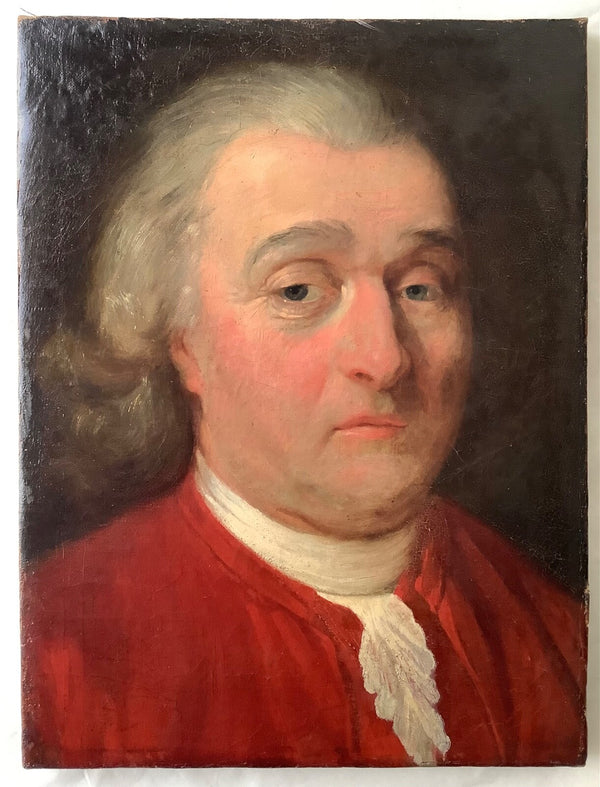
From our collection: 18th Century Portrait of a Nobleman with Powdered Wig, French School, 1750s
A French School portrait of the 1750s: a nobleman in a blue frock coat and powdered wig, painted with the assured technique the Paris academies drilled into every professional. Works like this, unattributed but unmistakably of their time, are exactly where informed collectors find quality that big names have priced out of reach elsewhere.
Reading a Portrait: Dating by Wig, Dress and Format
Even without a signature or a document, an 18th-century French portrait usually tells you when it was painted. Three things to look at:
Wigs and Hair
The great full-bottomed wig, cascading over both shoulders, belongs to the age of Louis XIV and lingers into the 1720s. From the 1730s men wear smaller powdered wigs with neat side curls and the hair tied back in a queue. By the 1780s many younger sitters wear their own hair, powdered and simply dressed. For women, the towering powdered coiffures belong to the 1770s, while softer, natural curls signal the 1780s.
Dress
Lace jabots and cravats, velvet coats and the robe a la francaise carry the mid-century. The muslin chemise dress, made fashionable and briefly scandalous by Marie Antoinette, marks the 1780s. A sitter in sober dark cloth with a high collar has usually crossed into the Revolutionary or Directoire years.
Format
Full-length portraits with columns and drapery were for royalty and the highest nobility. The bust-length and half-length formats, typically on canvases around 16 by 20 inches to 24 by 30 inches, served private clients and are what a collector will mostly encounter. Ovals enjoyed particular favor from the 1760s onward. These smaller formats were made for the private apartments of townhouses, which is why they sit so naturally in modern homes.
From our collection: French School, Portrait of a Woman with Hat, 18th Century
An 18th-century French School portrait of a woman in a hat, the kind of private, personal commission that formed the vast majority of portrait painting in the period. Try the dating exercise above on her dress and hair: reading a painting this way is one of the genuine pleasures of collecting in this field.
The Case for the Unknown Sitter
Collectors sometimes hesitate over portraits of unidentified sitters, and the market quietly rewards those who do not. A named royal or celebrity sitter adds a premium; an anonymous gentleman or lady of the same date, by a hand of the same quality, costs a fraction. Yet the painting itself, the thing you actually live with, is every bit as good. The anonymous portrait also carries a particular charge: a real person, dressed in their best, looking back across 270 years, with their name lost and their face perfectly preserved. Many seasoned collectors consider unknown sitters the single best value in Old Master painting.
After the Revolution: The Style Survives
The Revolution ended the world these portraits served, but not the craft. Painters trained under the old system kept working for a new clientele of citizens, officials and merchants. The manner of Louis-Leopold Boilly (1761-1845), precise, small in scale, quietly elegant, shows how French portraiture stepped from the Ancien Regime into the 19th century without losing its polish.
From our collection: Portrait of a Gentleman, Manner of Louis Boilly, Early 19th Century
A young gentleman in a dark blue coat, painted in the crisp, intimate manner of Boilly. The powdered formality of the old century has gone; the care over likeness and dress remains. A natural closing chapter for a collection built around 18th-century portraiture.
Starting Your Collection
A few practical notes for buying in this field:
Expect honest age. A 250-year-old canvas has almost always been relined (mounted on a new supporting canvas) and shows old restorations. This is normal conservation history, not damage. What matters is that the face, the most vulnerable and most important area, reads well.
Judge the face and the hands. These were painted by the most skilled hand in the workshop. Fabric and background could be delegated; the likeness could not. Quality in the face is the quickest test of a portrait's merit.
Take frames seriously. A period gilt wood frame is part of the object's history and adds real presence. Many 18th-century portraits still carry frames of the correct period, which is increasingly rare in other collecting fields.
Buy the painting, not just the name. Attribution language describes probability, not quality. A superb follower beats a weak autograph work on the wall every time. The collectors who do best in this field train their eye on faces, fabric and light, and let the labels follow.
Browse Our 18th-Century Paintings
Read More in Our Collecting Guides
This is the first article in our series on collecting French portraiture. Explore our other guides, including the full series on 19th-century French landscape painting and the Barbizon School, in our Collecting Guides.