Royal Portraits, Made to Be Copied
To view our antique portraits
Part of our Collecting Guides series.
A royal portrait was never meant to exist once. It was a face manufactured for distribution: fixed at court by one painter, then repeated by studio hands and independent workshops until it hung in every ministry, embassy, garrison and provincial hall that owed the crown its loyalty.

One face, a hundred rooms. The portrait painted at court was a master pattern, and its versions went out to ministries, embassies, garrisons, provincial halls and noble houses across the state.
The One Genre Where the Copy Is the Point
Every other kind of painting sets the original above the copy, and rightly. The state portrait inverts it. A sovereign had one face and needed a hundred, in a hundred rooms, at the same time. The picture painted from life was not the end of the process but the beginning of it: a master pattern, made in order to be reproduced.
Hyacinthe Rigaud understood this better than anyone and organised his studio around it. He kept account books recording, client by client, whether a portrait had left his premises entirely by his own hand, partly by assistants, or as a workshop replica he had supervised. That was not an admission of shortcuts. It was inventory management for an image that functioned as an instrument of government.
Where the Detail Goes
An official portrait and a private one are painted for opposite reasons, and it shows in what the picture describes carefully and what it leaves summary.
An official portrait finishes what carries the rank. On the Austrian canvases below, every ray of the star is drawn and every medallion of the cross is legible, while the face carries less detail than the decorations three inches beneath it. On the French royal portrait there is no insignia at all, and the rank is carried instead by the wig, the velvet and the lace, which are exactly the passages that receive the work. Different markers, same priority: what the client needed to be certain of was finished first.
A private portrait does the reverse. The face receives everything and the clothes are summary, because a face was the whole commission.
This is not a matter of quality, and not of nationality. It is a matter of what the picture was ordered to do.
Three Court Portraits
After Hyacinthe Rigaud, Royal Portrait, 18th century. Oil on canvas, carved gilt frame.
The wig is bigger than the man. Grey-blonde, full-bottomed, it falls in curls over both shoulders and takes up nearly half the canvas, leaving the face a small warm oval at its centre. Below it, a crimson velvet cloak and a deep fall of white lace at the throat, against a blue-grey ground. No star, no sash, no attribute of any kind.
The rank is in the hair, the velvet and the lace, and those are the passages the painter carried furthest. The wig also dates the picture, since the full-bottomed type belongs to the age of Louis XIV and lingers into the 1720s. An old paper label numbered 3 survives at the upper right, the trace of a collection that once inventoried this canvas among others.
And the picture is itself the argument of this page. It is not a Rigaud. It is a version of a Rigaud composition, made by another hand for somebody who needed that face on a wall, which is exactly what the composition existed to allow.
Austrian School, Emperor Joseph II, 19th century. Oil on canvas, gilt frame.
A very dark uniform coat with a scarlet standing collar and red facings, a lace cravat at the throat, a red and white watered sash across the chest. At the breast, a silver rayed star with a red centre, and above it an enamelled cross with red and white medallions. Pale hair swept straight back from a high forehead, blue eyes, the mouth closed and level.
Count what is described. Every ray of the star, every medallion of the cross, the two colours of the watered sash. Then look at the face immediately above them, which carries less detail than any of it. The part that had to be certain was finished first.
Joseph II died in 1790 and this canvas belongs to the century that followed. An emperor's face went on being repeated long after the man was gone, because what it asserted was never a person.
Austrian School, Emperor Francis I of Austria, early 19th century. Oil on canvas, 9 x 6 inches, gilt wood frame.
The white imperial coat with its blue standing collar, a lace jabot at the throat, a red and orange sash across the chest, a cross-shaped star at the left breast. Grey hair drawn back and tied at the nape, a very high forehead, the gaze turned slightly aside and past the viewer.
Nine inches by six. Francis I ruled from 1792 to 1835, dissolved the Holy Roman Empire and presided over the Congress of Vienna, and this is the size at which most of his subjects met him. Versions of his portrait went out across the empire throughout his reign and continued to circulate after his death, into government buildings, military installations and noble residences.
Set beside the Joseph II above, the pair shows how little the type moved. Two emperors, two reigns half a century apart, the same collar, the same sash, the same star in the same place. Recognition was the work of the uniform; the face was allowed to vary.
And One That Was Not
The three above were made to be repeated. This one was not, and setting it beside them is the quickest way to see what the difference actually consists of.
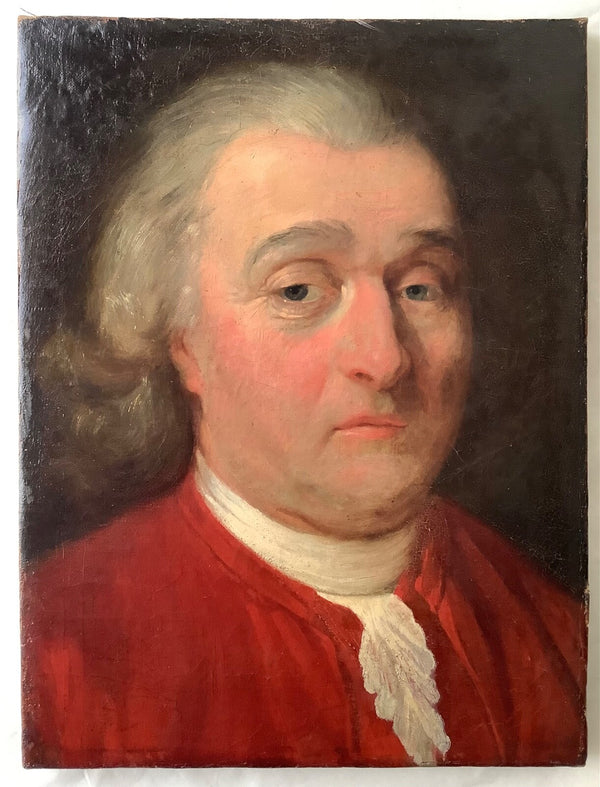
French School, Portrait of a Gentleman in a Red Coat, second half of the 18th century. Oil on canvas, relined, 15 3/4 x 11 3/4 inches, unframed.
A mature man in a deep red coat, a white stock with a lace fall at the throat, grey hair swept back and curling at the sides, against a dark olive ground. The coat is a flat mass with almost no drawing in it and the background is barely stated. The head carries everything: the heavy brow, the weight of the upper eyelid, the pouch beneath the eye, the ruddy flush across the cheek.
No insignia, nothing to certify, nothing repeated. This canvas was painted once, for one family, and no ministry ever wanted a version of it. Nobody outside that family would have recognised the man, and nobody was meant to.
What separates a state portrait from this is not style, and not quality. It is what the picture was for.
What Becomes of a Face When the Regime Falls
State portraits are the only paintings routinely destroyed for what they show rather than damaged by time. Revolutions and successions have always gone for the image first, because the image was the instrument. After 1793 the royal image became dangerous to own in France, and a great many were burnt, defaced or hidden. What survives has usually survived on purpose: taken down, turned to the wall, sent to the country, kept by a family who chose to keep it.
A royal portrait is not simply an old picture of a powerful person. It is an object made to serve a regime, which outlived the regime, and every one that still exists does so because somebody decided it should. That is where its value lies: not in the rarity of the hand, but in what it was made for and what it came through.
For what the word after claims on a canvas, see Period Copies After the Old Masters, and for the full vocabulary of attribution, our guide to Reading Attribution.
Browse our antique portraits →
Historical information on the reigns and on Rigaud's studio practice compiled from published reference sources, including the painter's own account books, long used by scholars to distinguish his autograph works from studio replicas. Diagram, photographs and descriptions of the paintings in our collection: GalerieClub Fine Art.