
Home›How to collect antique paintings›Salome and the Head of John the Bapti...
Salome and the Head of John the Baptist in Painting
To view our collection of religious paintings
Part of our series on the Women of the Gospels in Painting. See also our guides to Mary Magdalene, the Samaritan Woman at the Well, and Judith and Holofernes.
Salome is the young woman of the Gospels who danced before Herod and was granted, at her mother's prompting, the head of John the Baptist on a platter — and the platter is what identifies her in five centuries of European painting: a woman holding a severed head on a charger is Salome, a woman holding it by the hair is Judith.

Caravaggio, Salome with the Head of John the Baptist, c. 1607, Palacio Real, Madrid. (Wikimedia Commons.)
If Mary Magdalene weeps, the Samaritan Woman argues, and Judith acts, Salome does something none of them does. She dances. And then, having danced, she holds out a platter and accepts a severed head onto it, calmly, like a piece of fruit being offered at a banquet. She does not kill. She is the cause of the killing without ever touching the knife. That is what makes her, for five centuries of European painters, the most uncomfortable figure in the entire Gospel canon.
She is also the youngest. The Gospel of Mark calls her a korasion, a little girl, probably twelve or fourteen years old. Salome dances at her stepfather's birthday banquet, the king is so charmed that he swears in front of his court to give her anything she asks for, and she goes outside to ask her mother what to ask. Her mother tells her. She comes back in and asks for the head of John the Baptist on a platter. The head is brought. She carries it to her mother. That is the entire role she plays in the New Testament. Not a single line of dialogue spoken in her own voice. Twenty-three words of description from Mark, and the iconographic memory of half a millennium of European painting.
Painters could not let her alone. The Renaissance turned her into an Italian beauty holding a platter with the calm gaze of a portrait sitter. The Counter-Reformation made her a moral lesson on the dangers of dancing and feminine vanity. The seventeenth century gave her the dark theatrical lighting of Caravaggio's Naples. The nineteenth century, when the Salon painters and the Symbolists rediscovered her, turned her into the original femme fatale, sister to the Sphinx and the Sirens, embodiment of every cultural anxiety about female sexuality the fin-de-siècle could project onto a fourteen-year-old girl.
For collectors, this layered reception history is exactly what makes Salome paintings interesting. A Reni-school Salome from 1670 sits in the same iconographic family as a Henri Regnault Orientalist canvas from 1870 and a Klimt golden-leaf Salome from 1909. Three centuries, three completely different visual languages, one subject. Few other figures in Western painting offer that range.
Who Was She, Really?
The story is told in two Gospels, Matthew 14 and Mark 6, and in slightly more detail by the Jewish historian Josephus in his Antiquities of the Jews. John the Baptist, the desert preacher who baptised Christ, has been arrested by the tetrarch Herod Antipas because he publicly denounced Herod's marriage to Herodias, the wife of his half-brother. Herodias wants John dead. Herod is afraid of him, and reluctant. The marriage is unpopular and John has popular support.
At a banquet for Herod's birthday, attended by his court and military officers, the daughter of Herodias (the Gospels do not name her, Josephus does, she is Salome) comes in and dances. Herod is pleased. He swears in front of the assembled guests that he will give her anything she asks, up to half his kingdom. She goes out and consults her mother. Her mother says: ask for the head of John the Baptist on a platter. Salome returns, repeats the request, even adding the detail about the platter. Herod, trapped by his oath, sends a guard to the dungeon. The head is brought up. Salome carries it to her mother. That is the end of her appearance in the Gospel.
The historical Salome, if Josephus is to be trusted, was a granddaughter of Herod the Great, eventually married two more royal Herods, and ended her life as a queen of Armenia Minor. She had nothing further to do with John the Baptist or his cult. The figure painters spent fifteen hundred years depicting is almost entirely literary, a fusion of three sentences in Mark with later patristic commentary, medieval hagiography, and the imaginations of generations of painters.
That gives the subject its formal structure. Magdalene's iconography is built around penitence. Samaritan's around dialogue. Judith's around action. Salome's is built around an object: the platter, with the head of John on it. Everything in a Salome painting is organised around that single object and around the impossibility of looking at it without thinking about what is missing from it.
How to Recognise a Salome Painting
The platter. This is the single decisive attribute. The head of John the Baptist is presented on a platter (sometimes a charger, sometimes a shallow basin) held by Salome or set on a table beside her. If you see a woman with a severed head on a platter, you are looking at Salome. If you see a woman holding a severed head by the hair without a platter, you are looking at Judith. That single distinction is the most useful test in the entire iconography of decapitated saints.
The head of John the Baptist. Bearded, often with a wild halo of unkempt hair. Sometimes shown with closed eyes, sometimes with eyes half-open as if speaking from beyond death (a medieval and Counter-Reformation theological theme). The head is the visual centre of the composition, not Salome herself.
Salome's age and presentation. Always young, often barely adolescent. Renaissance painters dressed her as a contemporary noblewoman. Seventeenth-century painters gave her the kind of low-cut bodice that the period associated with feast scenes. Nineteenth-century Orientalists put her in Bedouin or Persian costume that owed more to ethnographic photography than to anything biblical.
The dance pose. In compositions that show the banquet rather than the aftermath, Salome is dancing, usually in profile, often with a tambourine or shawl. The dance composition is the rarer of the two iconographic variants. Most Salomes are post-dance, post-decapitation.
Herodias the mother. Often present in the background or to one side, sometimes pointing at the head, sometimes whispering instructions. She is older, harder-faced, and almost always painted as the morally responsible party. When she appears, the painting is moralising the story rather than seducing the viewer.
The executioner. A muscular male figure, sometimes shown handing over the head, sometimes sheathing his sword in the background. Caravaggio puts him directly behind Salome and lights him with the same single source.
No sword in Salome's hand. This is the negative test. She does not hold the weapon. Judith does. The presence of a sword in the woman's hand means you are looking at Judith.
The Painters Who Made the Subject
Bernardino Luini (c. 1480-1532)

Bernardino Luini, Salome with the Head of John the Baptist, c. 1527, Galleria degli Uffizi, Florence. (Wikimedia Commons.)
Luini, the Lombard follower of Leonardo, painted Salome at least four times. The Uffizi version is the most beautiful and the Cleveland Museum version the most accessible to American visitors. The formula was invented here: Salome at half length, looking down at or away from the head on the platter, with the executioner placing the trophy from one side. Luini's Salomes have the Leonardesque sfumato face, the high forehead, the half-lidded gaze. They are the calmest images of this subject in the entire tradition.
Luini set the template for the next two centuries. Every Italian Salome from Andrea Solario to Carlo Dolci descends, formally, from these compositions. The Cleveland version in particular is one of the great Northern Italian Renaissance paintings in any American museum.
Titian (c. 1488-1576)
.jpg?width=1200)
Titian, Salome with the Head of John the Baptist, c. 1515, Galleria Doria Pamphilj, Rome. (Wikimedia Commons.)
Titian's Doria Pamphilj canvas is one of the most quietly disturbing pictures of the Italian Renaissance. The young woman in a silk gown lifts a platter at the level of her chest. The head of John lies on the platter. She is looking away, lost in thought. There is no blood, no spectacle, no servant. It is a portrait of a girl who has just been given something she did not expect to be given.
There has been a long art-historical argument about whether this picture is actually a Judith. The head looks more like Holofernes than like John. There is no platter rim visible. Some scholars place it in the Judith tradition. Most still call it a Salome. Either way, it is one of the most influential treatments of the subject and the painting that gave the next two centuries of Italian masters the licence to treat the post-decapitation scene as a meditation rather than as a moral tale.
Lucas Cranach the Elder (1472-1553)

Lucas Cranach the Elder, Salome with the Head of John the Baptist. (Wikimedia Commons.)
Cranach painted Salome many times, and the resemblance to his Judith series is deliberate: same court dress, same red velvet, same gold trim, same direct gaze out at the viewer. He treated the two subjects as a paired iconographic problem and his patrons in the Saxon courts collected both. The platter is the only formal difference between his Salome and his Judith.
For collectors of Northern Renaissance painting, the Cranach Salomes are some of the most reproducible images of the subject. Workshop versions and later copies appear regularly on the market, almost always identifiable by the trademark Cranach palette and the small, almost doll-like proportions of the figures.
Caravaggio (1571-1610)
Caravaggio painted Salome twice. The first version, the Madrid canvas (image at the top of this article), was painted around 1607 in Naples, possibly as a propitiatory gift to the Grand Master of the Knights of Malta after Caravaggio's expulsion from the order. The second, smaller and even more melancholic, was painted in Naples in 1609 or 1610 and is now at the National Gallery in London. It may have been the last painting Caravaggio completed before his death.

Caravaggio, Salome with the Head of John the Baptist, c. 1609-10, National Gallery, London. (Wikimedia Commons.)
What Caravaggio did was strip the subject of its erotic colouring. His Salomes are not seductive. They are exhausted. The old servant beside the Madrid Salome (the same model Caravaggio used for Abra in his Judith) makes the picture into something almost domestic, an old woman and a young woman quietly managing a household catastrophe. The executioner stands behind, half in shadow, looking down at the head he has just placed.
The London version goes further. Three figures, all turning inward. Salome looks away. The executioner looks at her. The old servant looks at the head. There is no exchange of glance, no triumph, no horror. It is the quietest painting of a beheading ever made.
Guido Reni (1575-1642)

Guido Reni, Salome with the Head of Saint John the Baptist, c. 1639-42, Art Institute of Chicago. (Wikimedia Commons.)
Reni's Salome at the Art Institute of Chicago is the great Bolognese Baroque version, painted in his late style with the silvery palette and the cool, almost porcelain finish that made him the most copied painter of his century. Salome looks upward, away from the head, toward heaven, in a gesture that turns the whole composition into a meditation on guilt and grace. It is half history painting, half religious allegory, and it works on both registers.
As with Reni's Magdalenes and Lucretias, the workshop and follower versions of this composition are some of the most commercially viable Italian Baroque paintings on the market today. A genuine seventeenth- or eighteenth-century after-Reni Salome can deliver the visual impact of the autograph at a fraction of the cost. The Art Institute version is the touchstone for authenticating the type.
Henri Regnault (1843-1871) and Gustave Moreau (1826-1898)

Henri Regnault, Salomé, 1870, Metropolitan Museum of Art, New York. (Wikimedia Commons.)
The nineteenth century rediscovered Salome. Henri Regnault's 1870 canvas at the Metropolitan Museum is the painting that did it. A young woman in Orientalist costume, seated on a tiger-skin, holding a sword across her lap and a charger at her feet, with a knowing half-smile on her face. The picture was a Salon scandal and a critical sensation, and it put Salome back into the centre of late nineteenth-century visual culture for the next forty years.

Gustave Moreau, Salome Dancing Before Herod, 1876. (Wikimedia Commons.)
Moreau, working in Paris in the 1870s and 1880s, made Salome his lifelong subject. He painted her dozens of times, in oil and in watercolour, in dance poses and in standing poses, always in the same encrusted Byzantine-Egyptian-Persian fantasy costume that became the Symbolist visual vocabulary for the femme fatale. Salome Dancing Before Herod (Hammer Museum, Los Angeles) and The Apparition (Musée d'Orsay) are the two canonical pictures. They inspired Oscar Wilde's Salomé, Beardsley's illustrations, Richard Strauss's opera, and most of the popular Salome iconography of the early twentieth century.
For collectors of nineteenth-century academic and Symbolist painting, Salome is one of the most identifiable subjects of the period, and a strong Salon-school version, signed and dated 1870 to 1900, remains an attractive entry-point at the upper end of the academic market. The atelier Moreau, and the pupils it formed, are a story we tell elsewhere in our directory — including the painter Léon Printemps, who sat in that studio beside Matisse and Rouault.
Why Collectors Should Be Paying Attention
Salome occupies an unusual position in the religious painting market because she straddles two collecting traditions. On one side, the seventeenth- and eighteenth-century Catholic religious tradition that produced workshop Reni and Luini-school versions for churches and aristocratic chapels. On the other, the nineteenth-century academic and Symbolist tradition that turned her into a secular icon of fin-de-siècle decadence.
The two markets do not always overlap. A collector who buys a Reni-school Salome is usually buying Italian Baroque religious painting. A collector who buys a Regnault-school Salome is usually buying nineteenth-century academicism. The most interesting Salome collections combine both, recognising that the subject is what makes the dialogue between the periods visible.
For collectors building a small group of Baroque religious paintings, a workshop or after Reni or Luini Salome is a strong companion piece to a Judith, a Magdalene, or a Saint John the Baptist. The four together form a small thematic group that reads with real coherence on a single wall.
From Our Collection: The Territory Around Salome
Three period works from our collection occupy the ground directly around her: the saint whose head she demands, the iconographic family of Gospel women she belongs to, and the Renaissance lineage that produced the great Salome compositions. Each is a genuine period work, sourced from a private European collection.
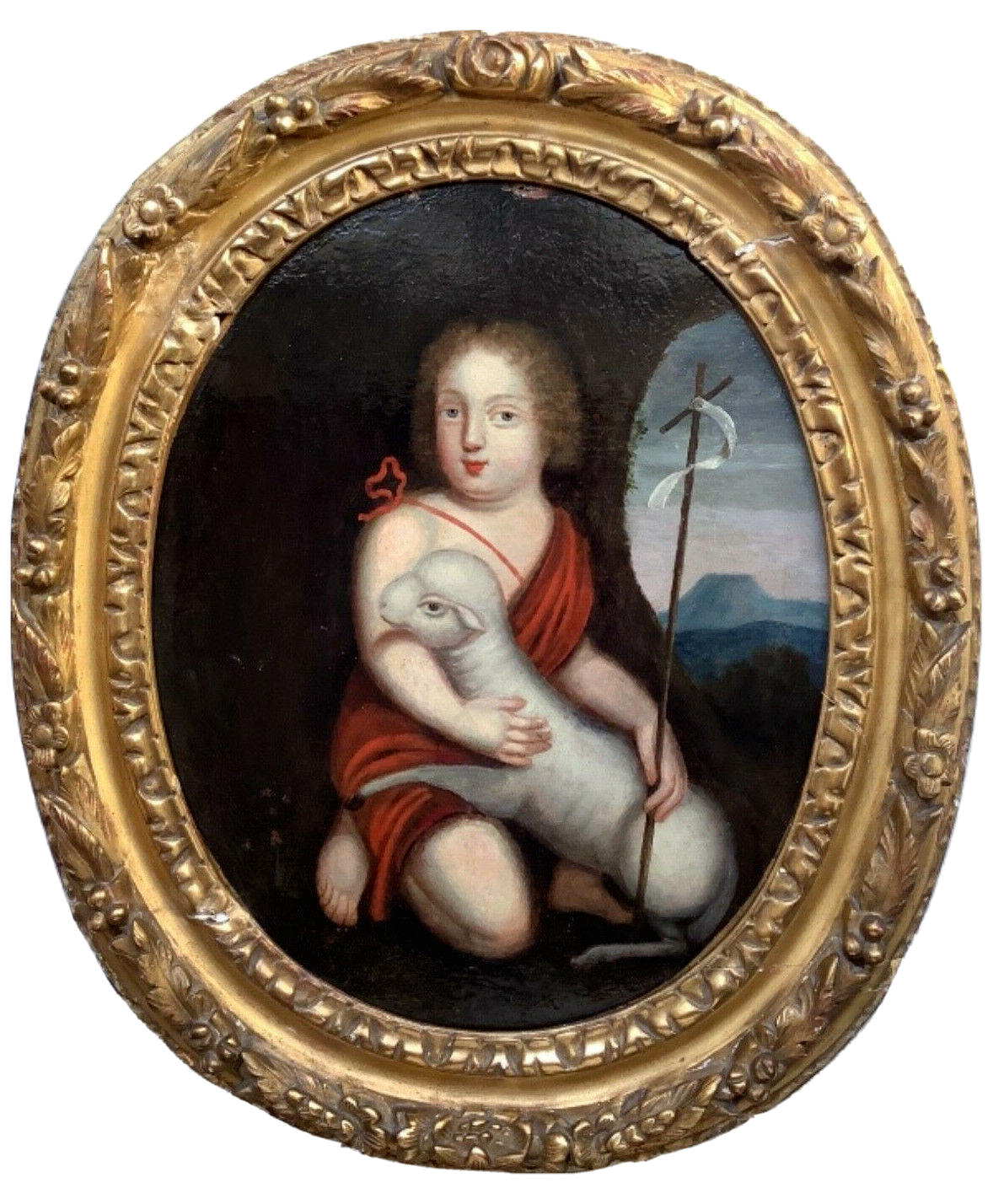
Circle of Pierre Mignard (1612-1695), Saint John the Baptist as a Child. Oil on canvas, in a gilt frame.
The figure whose head Salome will demand, painted here as a child with his attribute, the lamb. The Saint John as a Child was one of the most produced subjects of the French and Italian Baroque, and the Mignard circle specialised in these tender devotional images: the saint before his martyrdom, in the moment of innocence that the Salome iconography refers back to.
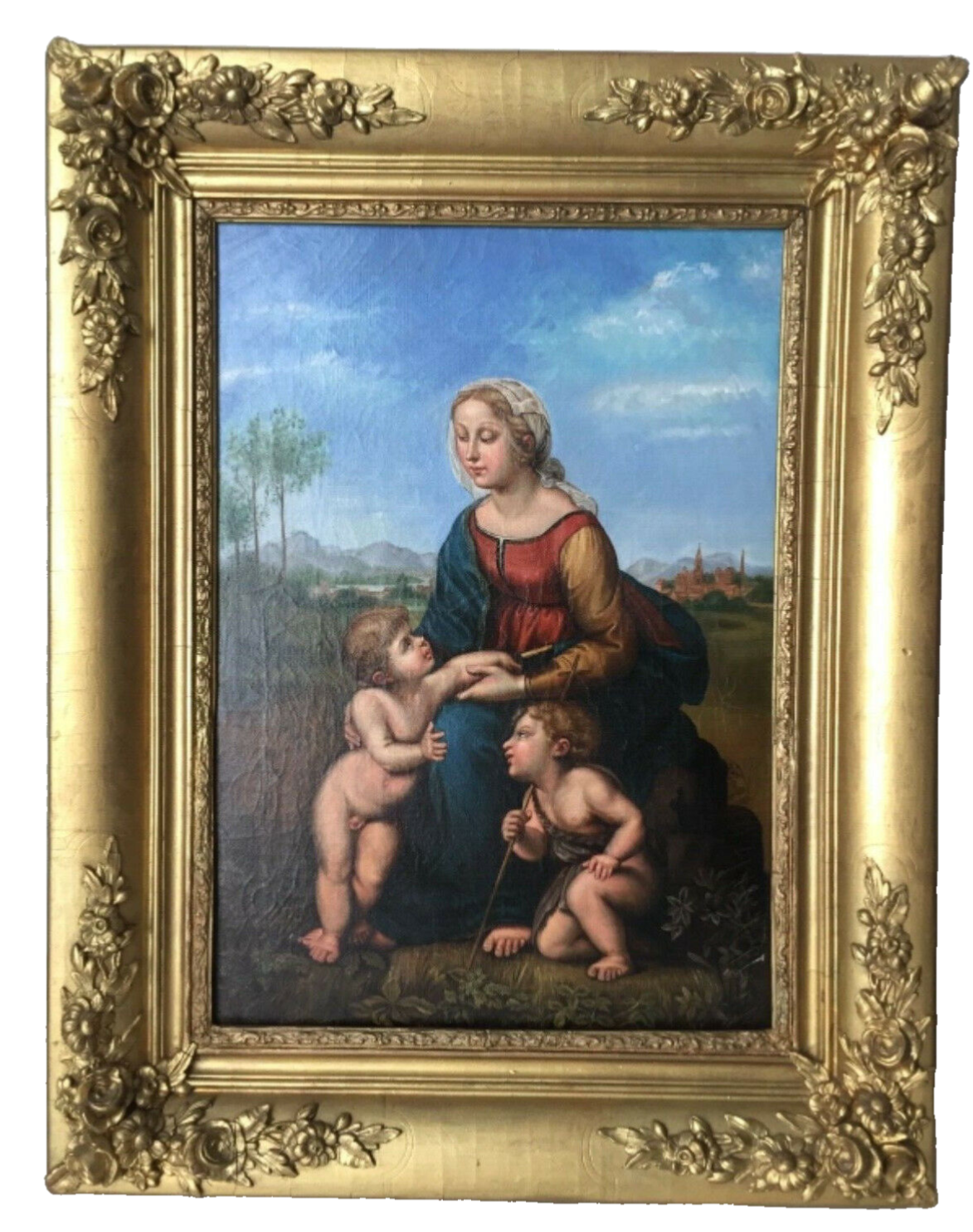
After Raphael Sanzio (1483-1520), Madonna and Child with St. John the Baptist. Nineteenth-century oil on canvas, framed.
The High Renaissance template that defined Italian religious painting for four hundred years, in a nineteenth-century period replica. Raphael's Madonna compositions were among the most copied images in Western art, and period after-Raphael canvases carry the same visual gravity as the originals. For a collector building a small religious group, this is the iconographic anchor: John the Baptist as a child, in the composition every later Salome painter knew by heart.
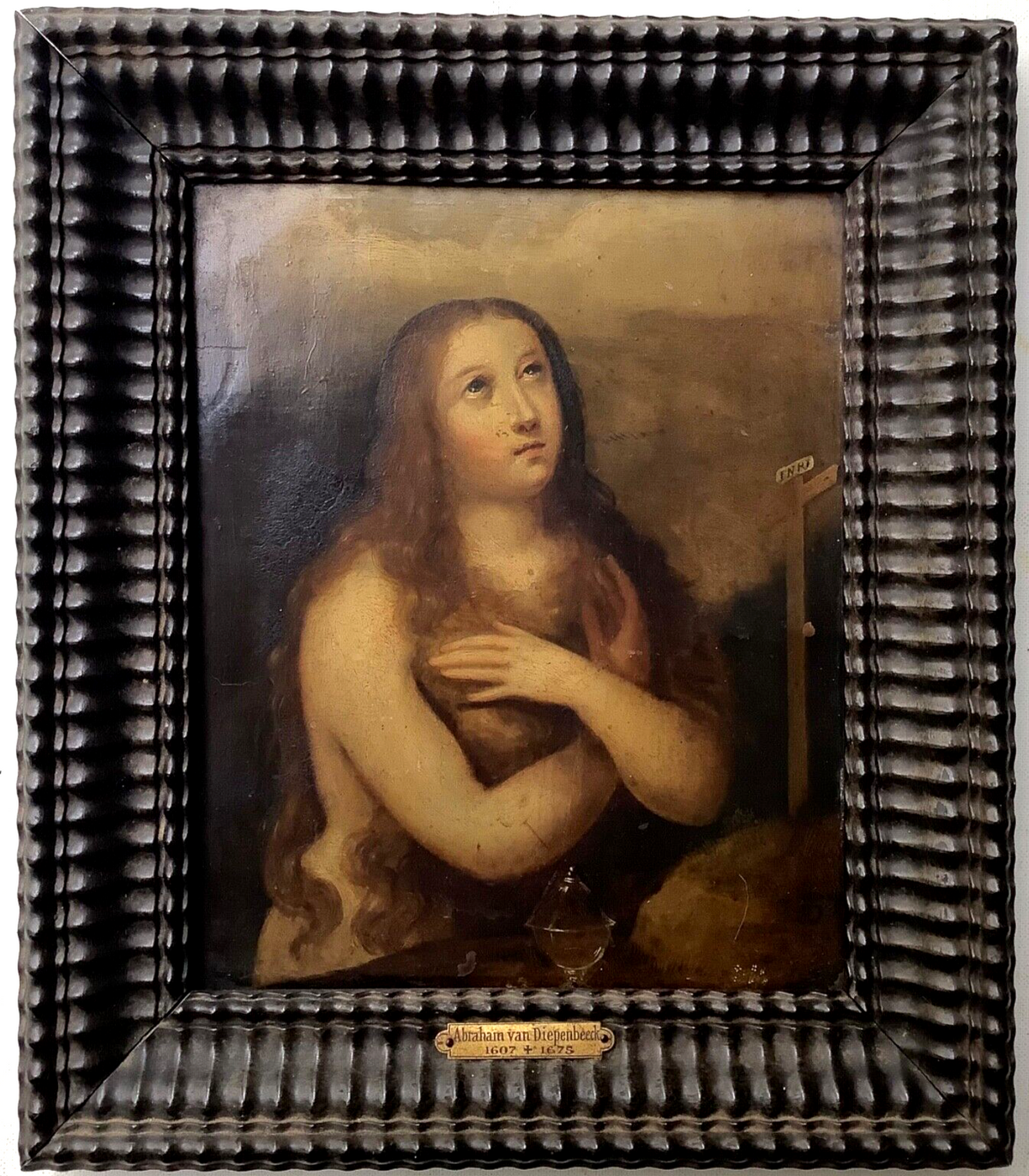
Circle of Abraham van Diepenbeeck (1596-1675), Mary Magdalene Repentant. Seventeenth-century Flemish oil on copper, framed.
The Magdalene is Salome's iconographic cousin: the other most-painted female figure of the New Testament, the other beauty associated with a male saint's body. This small Flemish copper, in the circle of one of the great Antwerp followers of Rubens, gives her the intimate cabinet treatment copper panels were favoured for. Pair it on a wall with a Salome and you have the two great female figures of the Counter-Reformation in dialogue.
Original paintings enter the United States free of duty, with free fine-art shipping to the US and Canada, and authenticity guaranteed on every painting.
Browse our religious paintings →
Where to See Salome in Museums
Caravaggio, Salome with the Head of John the Baptist, c. 1607. Palacio Real, Madrid.
Caravaggio, Salome with the Head of John the Baptist, c. 1609-10. National Gallery, London.
Titian, Salome with the Head of John the Baptist, c. 1515. Galleria Doria Pamphilj, Rome.
Bernardino Luini, Salome with the Head of John the Baptist, c. 1527. Galleria degli Uffizi, Florence.
Bernardino Luini, Salome with the Head of Saint John the Baptist. Cleveland Museum of Art, Ohio.
Bernardino Luini, Salome with the Head of Saint John the Baptist. Musée du Louvre, Paris.
Guido Reni, Salome with the Head of Saint John the Baptist, c. 1639-42. Art Institute of Chicago.
Lucas Cranach the Elder, Salome with the Head of John the Baptist. Museum of Fine Arts, Budapest; further versions in Lisbon, Madrid, Berlin.
Henri Regnault, Salomé, 1870. Metropolitan Museum of Art, New York.
Gustave Moreau, Salome Dancing Before Herod, 1876. Hammer Museum, Los Angeles.
Gustave Moreau, The Apparition, 1876. Musée d'Orsay, Paris.
All our guides are mapped in How to Collect Antique Paintings.
Museum works illustrated from Wikimedia Commons, as credited. Photographs and descriptions of the paintings in our collection: GalerieClub Fine Art.