
Home›How to collect antique paintings›Judith and Holofernes in Painting
Judith and Holofernes in Painting
To view our collection on Judith and Holofernes
Part of our series on the Women of the Gospels in Painting. See also our guides to Mary Magdalene and the Samaritan Woman at the Well.

Caravaggio, Judith Beheading Holofernes, c. 1598-99, Palazzo Barberini (Galleria Nazionale d'Arte Antica), Rome. (Wikimedia Commons.)
If Mary Magdalene weeps and the Samaritan Woman argues, Judith does something neither of them does. She kills a man. She brings a sword down on the neck of a sleeping general, saws through the gristle, lifts the head, hands it to her maid, and walks calmly out of the camp before dawn. She is the only woman in the entire visual canon of Western religious painting who is shown committing a murder, and she is celebrated for it.
That is the subject. A widow from a small Judean town walks into the enemy camp, charms the commanding general, gets him drunk, and beheads him in his tent. The next morning her people rout the leaderless Assyrian army. She returns to her town with the head in a bag, hangs it on the wall, and lives quietly to the age of one hundred and five, surrounded by her servants, refusing every offer of marriage.
It is, as stories go, perfect for painters. There is a beautiful woman. There is a powerful man, but not a god, an actual general, in his tent, with his armour off. There is a sword. There is a severed head, which European art has never tired of representing. There is a maidservant, which gives the painter a second figure to compose against the first. There is a tent, which provides drapery, candlelight, a contained space. And there is a moral framework that allows the whole thing to hang in a church or a cardinal's palace without scandal.
For nearly six hundred years, from the late medieval illuminations to Gustav Klimt, European painters could not leave Judith alone. The reason is not just iconographic. It is that Judith gave painters a way to think on canvas about the dangerous woman, the seductress, the avenger, the agent of God who acts through cunning rather than through faith. She is the dark counterpart of every other heroine in Christian art, and her market position today reflects exactly that combination of beauty, violence, and theological complexity.
Who Was She, Really?
The story sits in the Book of Judith, which is one of the deuterocanonical books, accepted by the Roman Catholic and Eastern Orthodox churches as scripture, treated as apocryphal by Protestants and Jews. It is set during a fictional siege of the Judean town of Bethulia by an Assyrian army led by Holofernes, the general of Nebuchadnezzar. The town is on the brink of surrender when Judith, a wealthy young widow, announces that she has a plan. She dresses in her finest clothes, takes her maid Abra and a sack of kosher food, and walks out of the gates toward the Assyrian camp.
Holofernes receives her in his tent. She tells him that her people have angered their God and that he, Holofernes, will be able to take the city without losing a man. He believes her. He spends four days drinking with her and admiring her. On the fourth night he invites her into his private tent for what he assumes will be a seduction. He drinks himself unconscious. She takes his own sword from above the bed, prays once, and strikes twice at the neck. The head comes free. She wraps it in the food bag, walks out past the sleeping guards with Abra at her side, and is back in Bethulia by dawn.
That is the story. The Book of Judith was written sometime between the second and first century BC, almost certainly in Hebrew, and survived only in Greek. The Catholic and Orthodox traditions kept it in the canon. The Protestant Reformation pushed it out. The painters did not notice. They went on painting Judith for another four hundred years, regardless of which Bible the buyer kept by the bed.
There is a formal difference between Judith and the other heroines of the Gospels. The Magdalene's story happens to her. The Samaritan Woman's story is a conversation. Judith's story is an action she plans, executes, and survives. She is the only one of the three who takes initiative, the only one who uses violence, and the only one who returns home alive and intact. Painters knew this. The pose they give her, in every great version, is one of focus and steadiness, not of grief or of doubt.
How to Spot Her in a Painting
The severed head. Holofernes's head, sometimes still bleeding, sometimes already dry, is the single most reliable attribute. It is held by the hair, set on a platter, or being placed into a sack by the maid. If you see a woman with a man's head and no other obvious context, you are looking at Judith. The only other comparable subject is Salome with the head of John the Baptist, and the test for distinguishing them is the platter (Salome) versus the bag or held-by-the-hair direct grip (Judith).
The sword. Often Holofernes's own scimitar or curved blade. Judith holds it in her right hand, sometimes resting on her shoulder, sometimes still wet. The sword is what separates her from the passive holders-of-attributes elsewhere in religious painting.
The maidservant Abra. A second female figure, almost always older than Judith, sometimes shown as a hooded crone, sometimes as a sturdy younger woman. She holds the sack into which the head is being placed. She is one of the very few servant figures in Christian art who is named in the text and given an active role.
The tent and the bed. Holofernes's body, when shown, is on a bed inside a tent, almost always draped in red. The candle or oil lamp gives painters the chance to do night-light, which is part of what made the subject irresistible to the Caravaggesques.
Judith's clothing. Rich. Embroidered. Often gold-trimmed. The Book of Judith makes a point of her dressing in her finest for the campaign, and painters obliged. The contrast between her ornamented body and the bare flesh of Holofernes is part of the composition's force.
No skull, no candle, no penitential attributes. Judith is not a Magdalene. The presence of the head is not a memento mori, it is the object of her action. If the head is on a platter, she becomes Salome. If there is no head, you are probably looking at a different biblical heroine.
The Great Judith Paintings
Sandro Botticelli (c. 1445-1510)

Sandro Botticelli, The Return of Judith to Bethulia, c. 1470-72, Galleria degli Uffizi, Florence. (Wikimedia Commons.)
Botticelli's small Uffizi panel is the early Renaissance template. Judith walks ahead, sword still in hand, looking back at her maid who carries the head wrapped in a cloth. The landscape behind them opens out toward the camp they have just left. The whole composition is built on rhythm, the swing of Judith's stride, the older maid hurrying to keep up, the breeze catching the cloak. There is no blood, no horror, no triumph. It is the morning after, calm, almost pastoral.
Botticelli understood something painters of the next century would forget: that the most powerful moment in the story is not the killing but the walking away. Almost every great Judith afterwards either chose the killing (Caravaggio, Artemisia) or the trophy (Cranach, Allori). Botticelli chose the return. It is one of the most quietly radical pictures of the early Renaissance.
Giorgione (c. 1477-1510)

Giorgione, Judith, c. 1504, State Hermitage Museum, Saint Petersburg. (Wikimedia Commons.)
Giorgione's Hermitage Judith is the great Venetian early version. She stands alone, full-length, in a green robe with one bare leg resting lightly on the head of Holofernes at her feet. The sword is in her right hand. The landscape behind her is calm. The painting is half portrait, half allegory, and it set the Venetian template for treating Judith as a vertical, contained, classical figure rather than as a participant in a violent action.
There is no blood on the sword. There is no maid. The head is more architectural plinth than trophy. The mood is the one Giorgione is famous for, contemplative, slightly melancholy, perfectly composed. It is the Judith for collectors who want the subject without the gore.
Lucas Cranach the Elder (1472-1553)
.jpg?width=1200)
Lucas Cranach the Elder, Judith with the Head of Holofernes, Metropolitan Museum of Art, New York. (Wikimedia Commons.)
Cranach painted Judith many times across his career, more than thirty surviving versions are documented, including those in Vienna, Kassel, Stuttgart, the Met, and Munich. The formula is consistent and instantly recognisable: a half-length Judith in a deep red velvet gown, ornate gold jewellery, a feathered hat, the sword held vertically in one hand, the severed head resting on a stone parapet beneath the other.
What Cranach did, and what made his Judiths so commercially successful in the German Reformation courts, was to strip the violence out and replace it with portraiture. His Judith is a Saxon noblewoman in court dress. She could be the wife of an elector. The head is almost decorative, like a hunting trophy on a sideboard. The painting reads as a portrait of virtue triumphing over tyranny, perfect for the Protestant princes who bought them.
The Met version is the one to see if you are in the United States. The painting is small, easily missed in the Northern Renaissance galleries, and once you have spent two minutes with it, hard to forget.
Caravaggio (1571-1610)
Caravaggio's Judith Beheading Holofernes, painted around 1598-99 for the Genoese banker Ottavio Costa and now in the Palazzo Barberini in Rome (image above), is the painting that broke the subject open. Everything previous painters had avoided, Caravaggio put on the canvas. The blade is mid-cut. The blood is arterial. Holofernes is awake, mouth open, screaming. Judith is leaning back, frowning slightly, doing the work like a butcher who has not done this before but is committed to seeing it through. Abra waits with the sack, an old woman with the face of someone who has watched many things.
The painting changed everything. It generated a school of followers, the Caravaggesques, who spent the next forty years rethinking the subject in dark rooms with single light sources. Artemisia Gentileschi saw it. Orazio Gentileschi saw it. Trophime Bigot saw it. So did Valentin de Boulogne, Manfredi, Honthorst. The Roman seventeenth century is full of Judiths that descend, directly or at one remove, from this single canvas.
If you are looking at any Judith from 1600 to 1650 that has dramatic chiaroscuro and visible violence, the composition can almost certainly be traced back to Caravaggio's Barberini canvas.
Artemisia Gentileschi (1593-c.1656)
%20by%20Artemisia%20Gentileschi-Uffizi.jpg?width=1200)
Artemisia Gentileschi, Judith Beheading Holofernes, c. 1620, Galleria degli Uffizi, Florence. (Wikimedia Commons.)
Artemisia painted Judith at least seven times. Two versions stand at the centre of her career, the Naples version at Capodimonte, painted around 1612-13 just after her trial, and the larger, more controlled Uffizi version of around 1620. Both are direct responses to Caravaggio. Both push the violence further than Caravaggio did.
What changes in Artemisia is the participation of Abra. In Caravaggio, the maid waits. In Artemisia, the maid holds Holofernes down. Two women, working together, pinning a struggling man to the bed and cutting his throat. The arms cross. The blood pumps in three directions. The whole composition is built like a piece of machinery, with Judith's right arm and Abra's right arm forming a diagonal that ends at the wound. It is one of the most brutally efficient compositions in seventeenth-century painting.
The market has caught up to Artemisia in the last decade. Major exhibitions at the National Gallery in London (2020) and the Metropolitan Museum (2022) confirmed her status. Documented Artemisia paintings now reach mid-seven figures at auction. Even attributed and circle-of works carry a premium. For collectors of Italian Baroque painting, Artemisia is no longer a curiosity, she is one of the central figures of the period.
Cristofano Allori (1577-1621)

Cristofano Allori, Judith with the Head of Holofernes, c. 1610-12, Galleria Palatina, Palazzo Pitti, Florence. (Wikimedia Commons.)
Allori's Pitti Judith is the most beautiful version of the subject and the strangest. The head of Holofernes is a self-portrait of the artist. The face of Judith is the artist's mistress, La Mazzafirra. The old maid Abra, leaning in behind, is the mistress's mother. It is a private revenge picture, painted as a kind of confession, and it became one of the most copied images in the seventeenth and eighteenth centuries.
The technique is jewelled. The fabric is so tightly painted you can count the embroidery threads. The flesh of the severed head is rendered with the same finish as the silks of Judith's gown. The whole picture is a meditation on beauty and ruin, painted at the very edge of taste, and it works.
Workshop versions, after-Allori copies, and seventeenth- and eighteenth-century replicas of this composition appear regularly on the market. They are some of the most attractive entry-points into Florentine Baroque painting at the upper end of mid-market collecting.
Gustav Klimt (1862-1918)

Gustav Klimt, Judith I, 1901, Österreichische Galerie Belvedere, Vienna. (Wikimedia Commons.)
Klimt's Judith I of 1901 is the last major Judith in Western art, and one of the strangest. She is shown in close-up, half-undressed, eyes heavy-lidded, gold leaf swarming over the background. The head of Holofernes is barely visible at the bottom right, almost cropped out of frame. The painting is no longer about the killing or the trophy. It is about the woman who has just killed, in the moment afterwards, in a state of erotic and spiritual aftermath that nineteenth-century critics found genuinely shocking.
It is also the painting that pulled Judith out of the religious canon and into the Symbolist and Decadent imagination, where she joined Salome and the Sphinx as one of the great femme fatale subjects of fin-de-siècle Vienna. After Klimt, the subject more or less stops being painted. The twentieth century did not need her any more.
Why Collectors Should Be Paying Attention
Judith and Holofernes is in a curious position in the market. The major autograph works (Caravaggio, Artemisia, Klimt) are out of reach, in public collections or commanding museum-level prices on the rare occasion they appear at auction. But the seventeenth and eighteenth centuries left an enormous secondary repertoire: workshop versions of Allori and Reni, Caravaggesque follower paintings from Rome and Naples, German and Flemish derivations of Cranach, French academic treatments by Vouet and his circle, and a long Italian provincial tradition that continued the subject through to the early 1800s.
These secondary works are where the collecting opportunity sits. A period Italian Baroque Judith with the Head of Holofernes, follower of Allori or after Reni, with good provenance and intact condition, occupies the same wall as a documented Magdalene but at a fraction of the price. The Artemisia effect has pulled attention to the subject without yet pulling up the bottom of the market. That window is narrowing.
For collectors building a small group of religious Old Masters, a Judith offers what no other female biblical subject offers: action, drama, and a heroine who is doing rather than being acted upon. It is also one of the few subjects in this tradition that reads convincingly in a contemporary domestic setting. A Penitent Magdalene asks something of the viewer. A Judith answers a question they did not know they were asking.
From Our Collection: Three Old Testament Paintings That Share Judith's Territory
We do not currently have a Judith and Holofernes in stock. But three period paintings in our current collection occupy the same Old Testament Baroque ground that produced the great Judith canvases: biblical women in dramatic narrative, eighteenth-century rococo religious painting, and Flemish Old Master treatments of violent scripture. Each is a genuine period work, sourced from private European collections, presented with full provenance.
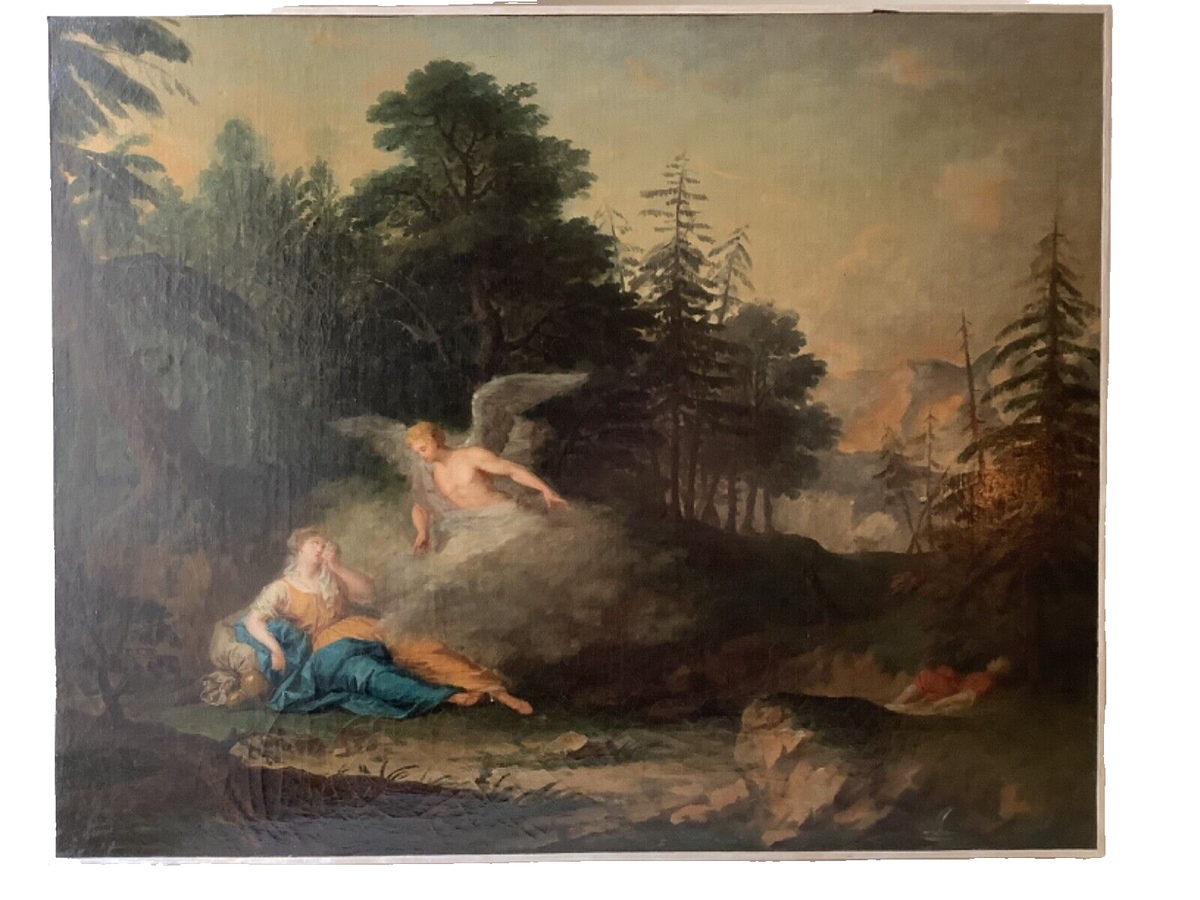
18th-century German Rococo, attributed to Januarius Zick (1730-1797). Oil painting, biblical narrative.
The Old Testament heroine cast out into the desert with her son, saved by the angel who shows her the well. The composition follows the Counter-Reformation tradition of presenting the female biblical figure in a moment of divine intervention rather than active defiance, but the dramatic lighting and emotional intensity place it in the same Baroque-to-Rococo lineage that produced the great Judith canvases. The attribution to Januarius Zick, one of the leading German Rococo religious painters, gives the work a clear stylistic anchor.
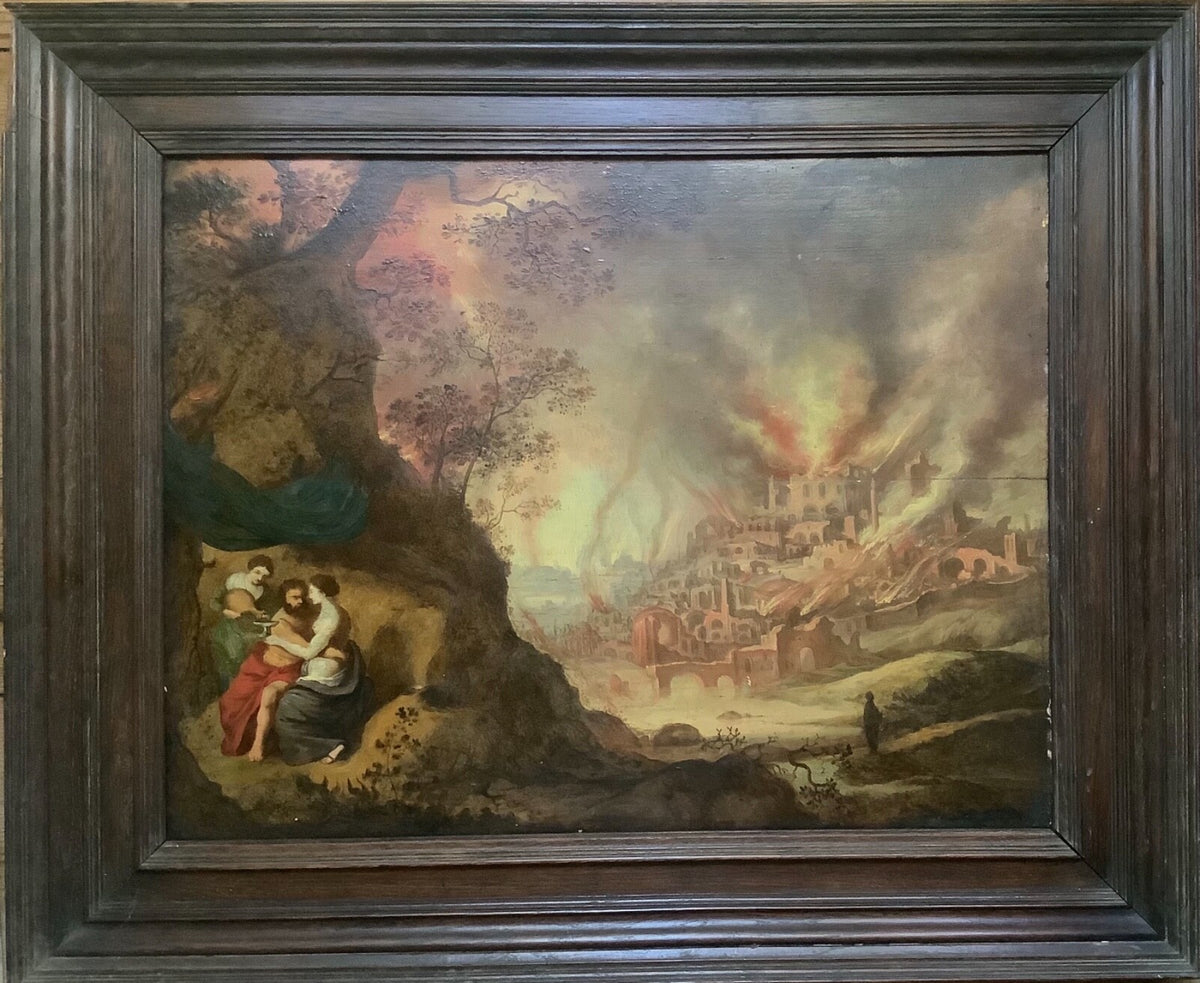
Flemish Old Master, close to Gillis Mostaert (1528-1598). Oil on wood panel, framed.
Of the three works here, this is the closest in sensibility to a Judith. The Fire of Sodom, Lot and his Daughters is an Old Testament narrative of biblical violence, divine judgement, and a fraught female agency that runs through the entire Genesis tradition. The Flemish Mannerist treatment, with its small-figure narrative composition and panoramic burning city, descends directly from the school of Gillis Mostaert and the dramatic biblical landscape painters working in Antwerp in the late sixteenth century. For a collector who wants the Old Testament Baroque drama at a smaller, more cabinet-friendly scale, this is the painting.
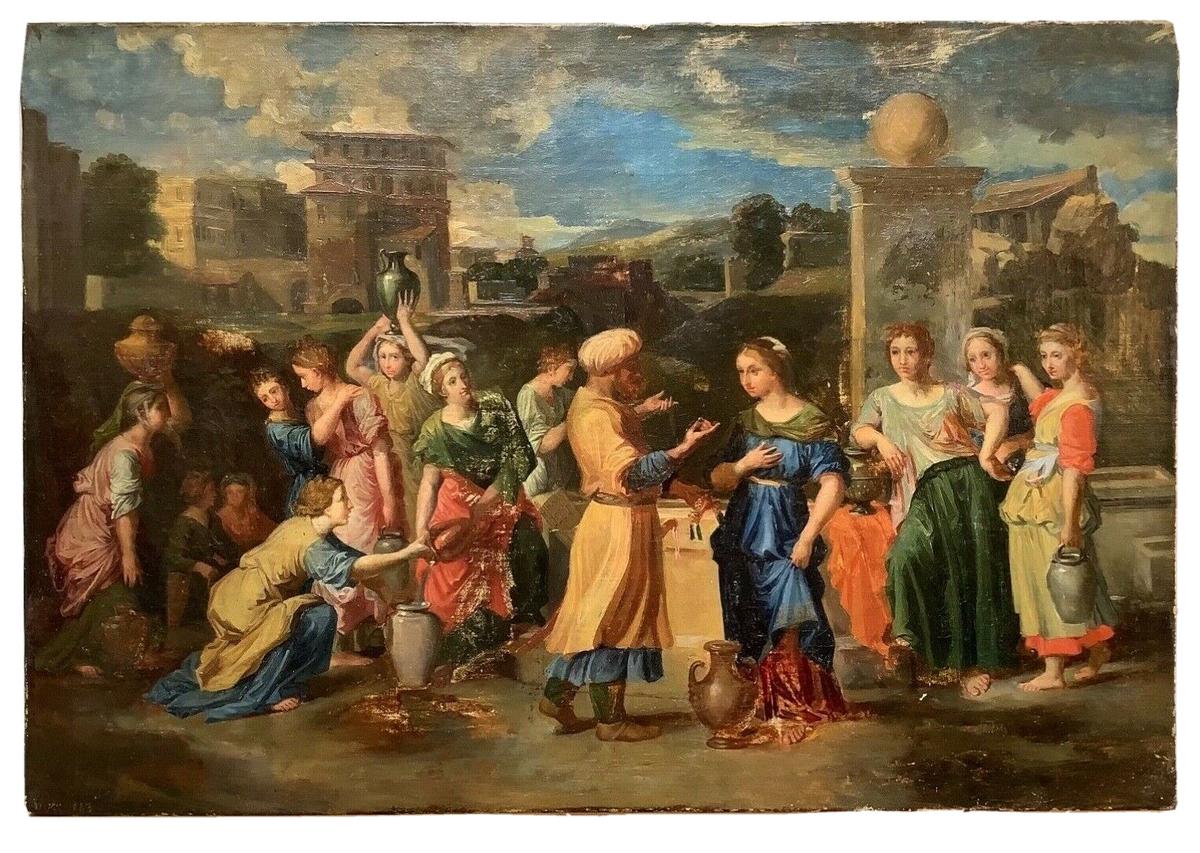
French Old Master, after Nicolas Poussin (1594-1665). Oil painting, biblical narrative, unframed.
Another Old Testament heroine, this time at the well: Rebecca offering water to Abraham's servant Eliezer, the moment that begins her marriage to Isaac. The composition follows Poussin's celebrated 1648 canvas now in the Louvre, one of the foundational works of French classicism. Period after-Poussin works carry the visual gravity of the original and the academic discipline that ran from Poussin through Champaigne to Jouvenet, the lineage that also shaped the great French Judiths of the seventeenth century. A direct compositional counterpart to our Samaritan Woman at the Well article.
Browse all our religious paintings
A reminder for our American customers: no federal tariffs on original paintings imported into the United States. Free fine-art shipping to the US and Canada. Authenticity guaranteed on every painting.
Key Paintings to See in American and European Museums
Caravaggio, Judith Beheading Holofernes, c. 1598-99. Palazzo Barberini (Galleria Nazionale d'Arte Antica), Rome.
Artemisia Gentileschi, Judith Beheading Holofernes, c. 1612-13. Museo Nazionale di Capodimonte, Naples.
Artemisia Gentileschi, Judith Beheading Holofernes, c. 1620. Galleria degli Uffizi, Florence.
Artemisia Gentileschi, Judith and Her Maidservant, c. 1623-25. Detroit Institute of Arts, Michigan.
Sandro Botticelli, The Return of Judith to Bethulia, c. 1470-72. Galleria degli Uffizi, Florence.
Giorgione, Judith, c. 1504. State Hermitage Museum, Saint Petersburg.
Lucas Cranach the Elder, Judith with the Head of Holofernes. Metropolitan Museum of Art, New York; further versions in Vienna (Kunsthistorisches), Kassel, Stuttgart, Munich.
Cristofano Allori, Judith with the Head of Holofernes, c. 1610-12. Galleria Palatina, Palazzo Pitti, Florence.
Donatello, Judith and Holofernes (bronze), c. 1457-64. Palazzo Vecchio, Florence.
Gustav Klimt, Judith I, 1901. Österreichische Galerie Belvedere, Vienna.
Gustav Klimt, Judith II, 1909. Galleria Internazionale d'Arte Moderna di Ca' Pesaro, Venice.
Read More in This Series
Mary Magdalene in Painting, the first in our series on the Women of the Gospels.
The Samaritan Woman at the Well in Painting, the second article in the series.
Coming next: Salome and the Head of John the Baptist. Susanna and the Elders. The Woman Taken in Adultery. Bathsheba in Painting.