
Skip to content

Free worldwide shipping on orders over $1500 — Authenticity guaranteed on every painting

shop now

Cart

Your cart is empty

Article: Haystacks in French Painting: Before and After Monet

Haystacks in French Painting: Before and After Monet

Haystacks in French Painting: Before and After Monet

To view our collection of French landscape paintings with haystacks

Part of our series on the French 19th-Century Landscape School. See also our pillar guide to The Barbizon School in Painting and our guide to Pastoral Scenes.


Claude Monet, Haystacks, end of Summer (Meules, fin de l'été), 1891, Musée d'Orsay, Paris

Claude Monet, Haystacks, end of Summer (Meules, fin de l'été), 1891, Musée d'Orsay, Paris. (Wikimedia Commons.)

The first thing to understand about haystacks in French painting is that Monet did not invent them. By the time he started his famous Meules series at Giverny in 1890, French painters had been painting haystacks for sixty years. Millet painted them in the 1850s. Daubigny painted them. Pissarro painted them. The Barbizon generation painted them as part of the standard rural vocabulary, alongside cows, hayfields, peasants, and skies. What Monet did was take a subject everyone already knew and make it the entire painting.

That distinction matters for collectors. A haystack canvas painted in France between 1850 and 1900 is not automatically a Monet derivative. Many of them predate Monet's series. Others come from painters working in parallel to him, with no clear influence in either direction. The pre-Monet haystack tradition has its own logic, its own painters, and its own market, separate from the Impressionist series that gets all the auction headlines.

This article is about that broader tradition. What it looked like before Monet, what changed after, and where signed period haystack canvases sit in the market today.

Why Painters Painted Haystacks

The haystack was, in the second half of the nineteenth century, the most visible piece of rural French architecture after the farmhouse. You could not walk through any agricultural region of France between June and October without seeing them. They were built by hand, often eight to fifteen feet tall, conical or rounded, set in groups of three to ten across a freshly cut field. They sat for weeks or months, slowly being pulled apart for animal feed through the autumn and winter.

For a painter trained to look at landscape, the haystack was a gift. It was a piece of geometry that the land produced naturally: a cone or cylinder sitting on a plane, casting a long oblique shadow, catching the light on one side and falling into deep blue-violet on the other. It read at a distance. It anchored a composition. It gave the painter a subject that was simultaneously realistic (it was right there in the field) and almost abstract (a pure volume of warm color against a horizon).

The first wave of painters who took the haystack seriously were the Barbizon Realists of the 1840s and 1850s. They painted haystacks as part of the harvest cycle, alongside peasants gathering wheat and oxen pulling carts. The next generation, the Impressionist circle of the 1870s and 1880s, painted haystacks differently: as standalone objects, often with the human figure absent, the focus shifting to the light effects rather than the agricultural narrative. Monet's series of the 1890s is the culmination of that shift, but it is not the beginning of it.

How to Read a French Haystack Painting

Look at the haystacks themselves. Are they painted as solid, weighty objects with visible texture (Barbizon), or as fields of broken color where the form dissolves into the light (Impressionist)? Most period haystack paintings sit somewhere on this spectrum.

Look at the figures. Are there people in the field, gathering or working? Or are the haystacks alone, with the figure absent? Pre-Monet haystack paintings almost always include figures. Post-Monet haystack paintings increasingly do not.

Look at the sky. The Barbizon painters gave the sky atmospheric weight, often half or more of the composition. The Impressionists more often pushed the haystacks closer to the picture plane and reduced the sky to a narrow band at the top.

Look at the brushwork on the foreground. Loose horizontal sweeps of thin paint that let the panel show through suggest the plein-air panel tradition that ran from Barbizon to early Impressionism. Heavier impasto with palette knife marks suggests the later Realist-Impressionist hybrid that dominated French regional painting from the 1880s onward.

Look at the signature. Most period haystack canvases are signed, often lower right. The signature places the painter, sometimes dates the work, and is the single most useful piece of information you have for evaluating the painting's historical position.

The Great Haystack Painters

Jean-François Millet (1814-1875)

Millet is the painter who established the haystack as a serious subject. His harvest scenes from the 1850s and 1860s, particularly the works at the Musée d'Orsay and the Museum of Fine Arts in Boston, show haystacks as part of the broader cycle of rural labor: women gleaning at the foot of a stack, farmers loading carts, the field slowly being cleared. The haystack in Millet is never abstract. It is always tied to the work that produced it and the people who built it.

Léon-Augustin Lhermitte (1844-1925)

Léon-Augustin Lhermitte, Haymaking, Musée d'Orsay, Paris

Léon-Augustin Lhermitte, Haymaking (La Faneuse), Musée d'Orsay, Paris. (Wikimedia Commons.)

Lhermitte was the most celebrated peasant painter of the post-Millet generation. He worked in pastel and oil, painting harvest scenes with a luminosity that put him squarely between the Barbizon Realists and the Impressionists without belonging fully to either camp. His Haymaking at the Musée d'Orsay shows a young woman raking hay in a field at the height of summer, the light flat and intense, the haystacks suggested in the middle distance. Vincent van Gogh, writing from Arles in 1888, called Lhermitte "the absolute master of the figure" and copied his compositions repeatedly.

Lhermitte's market is one of the most quietly strong in the late-Realist category. His harvest scenes sell consistently and slowly appreciate. His name is one to learn.

Jules Bastien-Lepage (1848-1884)

Jules Bastien-Lepage, Les Foins (Haymaking), 1878, Musée d'Orsay, Paris

Jules Bastien-Lepage, Les Foins (Haymaking), 1878, Musée d'Orsay, Paris. (Wikimedia Commons.)

Bastien-Lepage's Les Foins, exhibited at the 1878 Salon and now at the Musée d'Orsay, is one of the great haystack paintings in nineteenth-century French art. A peasant woman sits exhausted at the front of the composition, her face vacant with fatigue, her hands resting on her lap. Behind her, a man in a striped shirt lies in the grass, asleep, while in the background the field stretches toward a line of haystacks under a hazy sky. The painting was politically charged. The figures look like real people, exhausted by real work, with no academic prettifying. Bastien-Lepage died young, at thirty-six, but his short career left a stamp on the entire late-Realist tradition.

Camille Pissarro (1830-1903)

Camille Pissarro, Haystacks, Morning, Éragny, Metropolitan Museum of Art, New York

Camille Pissarro, Haystacks, Morning, Éragny, Metropolitan Museum of Art, New York. (Wikimedia Commons.)

Pissarro painted haystacks throughout his career, but the canvases he made at his property in Éragny in the 1890s are the most fully realized. The example at the Met shows two haystacks in a field under a morning sky, the light just starting to come up, the foreground built in broken touches of green and ochre. Pissarro was the only Impressionist who came directly out of the Barbizon tradition (he had studied with Corot in the 1850s), and his haystack paintings show that lineage clearly. They have the structural weight of Barbizon and the broken-color brushwork of Impressionism in the same image.

Claude Monet (1840-1926)

Monet painted his Meules series at Giverny between 1890 and 1891. He worked on twenty-five or so canvases simultaneously, moving from one to the next as the light changed, painting the same two or three haystacks under every conceivable atmospheric condition: morning, midday, sunset, fog, snow, frost, end of summer, mid-winter. The series was exhibited together in May 1891 at the Galerie Durand-Ruel and made Monet a wealthy man. Fifteen of the canvases sold in three days. The American collectors who bought them (the Havemeyers, Mrs. Potter Palmer, the Searses) effectively transferred the haystack subject from a category of rural realism to a category of pure aesthetic experience.

The Meules canvases now live at the Musée d'Orsay, the Art Institute of Chicago, the Museum of Fine Arts in Boston, the Met, the Hill-Stead in Connecticut, and a handful of other major collections. The market for them is the upper Impressionist range. They have changed how all subsequent haystack painting is read.

Why Collectors Should Be Paying Attention

Three things make the haystack category interesting right now.

The first is the visual coherence. A small group of haystack paintings, hung together, reads as a body of work in a way that very few other late nineteenth-century categories do. The subject is consistent enough that you can compare brushwork, palette, and compositional choices across painters and quickly form your own eye. This makes it one of the best entry points for a new collector who wants to learn how to look at French Realist and Impressionist landscape work.

The second is the price stratification. At the top of the market, Monet's Meules canvases sell at auction for over a hundred million dollars. Below that, signed haystack canvases by Lhermitte, Bastien-Lepage, and Pissarro trade in the mid six figures. Below that again, signed period haystack paintings by accomplished provincial Realists trade in the low five figures. A patient collector working in the lowest band can build a coherent group at prices that, twenty years from now, will look like a different market entirely.

The third is the durability of the subject. A field with three haystacks under a summer sky is the same image whether it was painted in 1850 or 2026. The painting does not need contemporary art-historical context to be moving. It belongs on any wall, in any season. Auction prices have remained steady or risen across the past decade. Museum interest in the late-Realist haystack tradition (beyond just Monet) has been quietly growing. Any signed haystack canvas of quality is now a real holding.

From Our Collection

We currently hold four period haystack canvases, all by painters working within the Barbizon-to-Impressionist tradition that fed directly into what Monet would later do at Giverny. Each is a period work, sourced from private European collections, with full provenance.

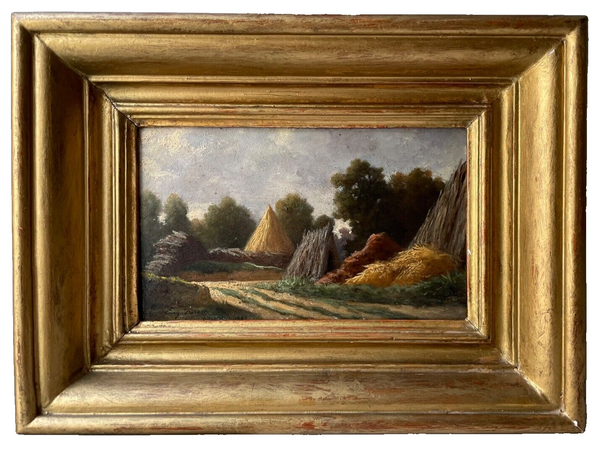
Adolphe Felix Cals, Haystacks Landscape, signed oil on canvas, available at GalerieClub Fine Art

Adolphe Felix Cals (1810-1880), Haystacks Landscape. Signed oil on canvas, 7 x 13 inches.

The most historically important haystack canvas in our current collection. Cals participated in the first Impressionist exhibition of 1874, alongside Monet, Renoir, Pissarro, and Sisley. His work is held at the Musée d'Orsay and the Musée des Beaux-Arts de Rouen. This small canvas shows two haystacks under a low Normandy sky in the warm earth palette and broken brushwork that links his work directly to the Barbizon tradition while pointing forward to the Impressionist haystack paintings that would follow. Painted at Honfleur in the years before Cals's death in 1880, this canvas predates Monet's Meules series at Giverny by fifteen years.

View this painting

Eugene Forest, Haystacks Landscape 1882, signed Barbizon School oil on wood panel, available at GalerieClub Fine Art

Eugene Forest (1808-1891), Haystacks Landscape 1882. Signed and dated oil on wood panel, 5 x 9 inches.

A small, dated plein-air haystack panel by a Benezit-listed Barbizon painter, painted in his last decade. The composition is built around the haystacks themselves: heavy, golden, anchoring the lower half of the panel against a sky that opens into cool blues. The handling is direct and confident, with thin layered paint that lets the wood grain show through in places. The palette stays inside the disciplined Barbizon range of ochre, raw sienna, muted green-gray, and pale sky. Painted nine years before Monet started his Meules series, this is exactly the kind of small, observed haystack canvas that the Impressionist generation took as a starting point.

View this painting

Gaston Bonfils, Haystacks in a French Harvest Landscape, signed oil on panel, available at GalerieClub Fine Art

Gaston Bonfils (1855-1946), Haystacks in a French Harvest Landscape. Signed oil on wood panel, 9 x 13 inches.

A late-Realist haystack composition built around five or six conical stacks set in a loose diagonal across a stubble field, painted in the warm gold of late summer. The brushwork is direct and physical, with thick ridges of ochre and raw sienna laid down with a palette knife or stiff brush, giving the haystacks an almost sculptural weight that distinguishes Bonfils from the smoother handling of his Barbizon predecessors. This is the post-Monet haystack tradition, where the visual logic of the Impressionist series has filtered back into the broader French landscape practice. Signed "G. Bonfils" lower right.

View this painting

Alexandre Gaston Guignard, Sheeps in a Haystack Landscape, signed oil on canvas, available at GalerieClub Fine Art

Alexandre Gaston Guignard (1848-1922), Sheeps in a Haystack Landscape. Signed oil on canvas, 12 1/2 x 16 inches.

A hybrid composition that combines two of the most representative subjects of nineteenth-century French rural painting: a flock of sheep gathered near haystacks, with a shepherd figure integrated into the scene. The warm golden palette and the broad atmospheric handling place the work squarely in the Barbizon-descended Realist tradition. The canvas bears a wax stamp on the reverse from the Paris color merchant Alexis Ottoz, confirming it as a period support used by a professional painter. Signed "Gaston Guignard" lower left.

View this painting


Browse all our French 19th-century landscape paintings

A reminder for our American customers: no federal tariffs on original paintings imported into the United States. Free fine-art shipping to the US and Canada. Authenticity guaranteed on every painting.

Key Paintings to See in American and European Museums

Claude Monet, Haystacks, end of Summer (Meules, fin de l'été), 1891. Musée d'Orsay, Paris.
Claude Monet, Stacks of Wheat (End of Day, Autumn), 1890-91. Art Institute of Chicago.
Claude Monet, Grainstack (Sunset), 1891. Museum of Fine Arts, Boston.
Claude Monet, Haystacks, Snow Effect, 1891. National Galleries of Scotland, Edinburgh.
Camille Pissarro, Haystacks, Morning, Éragny. Metropolitan Museum of Art, New York.
Jules Bastien-Lepage, Les Foins (Haymaking), 1878. Musée d'Orsay, Paris.
Léon-Augustin Lhermitte, Haymaking (La Faneuse). Musée d'Orsay, Paris.
Jean-François Millet, Buckwheat Harvest, Summer, 1868-74. Museum of Fine Arts, Boston.
Jean-François Millet, Harvesters Resting (Ruth and Boaz), 1850-53. Museum of Fine Arts, Boston.

Read More in This Series

This is the third article in our cluster on the French 19th-Century Landscape School. The earlier guides cover the broader Barbizon tradition and the pastoral category that produced many of the same painters who worked on haystacks.

The Barbizon School in Painting, the pillar guide that sets the historical frame.

Pastoral Scenes, Shepherds and Sheep in 19th-Century French Painting, the related guide to the rural figure tradition.

Coming next: Animated Landscapes, Figures in 19th-Century French Painting. French Impressionist Landscape Painting Beyond the Famous Names.

To view our collection of French landscape paintings with haystacks

Read more

Pastoral Scenes - Shepherds and Sheep in 19th-Century French Painting
Barbizon

Pastoral Scenes - Shepherds and Sheep in 19th-Century French Painting

To view our collection of French pastoral paintings Part of our series on the French 19th-Century Landscape School. See also our pillar guide to The Barbizon School in Painting. Jean-François Mil...

Read more
Animated Landscapes: Figures in 19th-Century French Painting
Animated landscape

Animated Landscapes: Figures in 19th-Century French Painting

To view our collection of French landscape paintings with figures Part of our series on the French 19th-Century Landscape School. See also our pillar guide to The Barbizon School in Painting and o...

Read more