
Home›How to collect antique paintings›Choosing an Antique Painting for Abov...
Choosing an Antique Painting for Above the Fireplace
Before you choose the painting, measure the shelf. A mantelpiece decides the antique painting that goes above it, and the rule is that the framed width should span roughly two thirds to three quarters of the mantel.
Take a tape to the shelf now. A French marble chimneypiece is usually forty-eight to fifty-four inches wide. An American mantel runs wider, often sixty or more. A country chimneypiece can be anything.
Swipe →
| The same mantel, three widths | ||
| Under two thirds | Two thirds to three quarters | Over three quarters |
| Marooned on the chimney breast. | Settled. The picture belongs to the fireplace. | Overhanging the shelf, and reading as too big for the wall. |
Swipe →
| Measure your mantel, read across | ||
| Every measurement is of the painting in its frame, not of the canvas. | ||
| Your mantel | Look for this framed width | Hang or stand |
| 30 in76 cm | 20 to 22 in51 to 56 cm | Stand |
| 40 in102 cm | 27 to 30 in69 to 76 cm | Either |
| 48 in122 cm | 32 to 36 in81 to 91 cm | Hang |
| 54 in137 cm | 36 to 40 in91 to 102 cm | Hang |
| 60 in152 cm | 40 to 45 in102 to 114 cm | Hang |
| 72 in183 cm | 48 to 54 in122 to 137 cm | Hang |
| Below two thirds the painting looks marooned. Above three quarters it overhangs the shelf. | ||
One thing catches people out. A period gilt frame adds four to eight inches across, and considerably more if it is ornate. A canvas that looks too small on paper often turns out exactly right once framed, and the reverse happens just as often. Every antique oil painting on this site gives both the canvas and the framed size for that reason.
Four to eight inches of clearance
How High to Hang a Painting Above a Fireplace |
Leave four to eight inches between the top of the shelf and the bottom of the frame. Less than four and the painting looks glued to the mantel. More than eight and it drifts up the chimney breast and loses its connection to the fireplace.
The objects on the shelf matter more than most guides admit. A pair of candlesticks or a clock will occupy the space you were counting on, and the picture has to clear them. This is the commonest reason a painting that measured correctly still looks wrong once it is up.
And a great many French chimneypieces already carry a trumeau, the tall overmantel mirror set into the panelling above the shelf. When that is the case the argument is over. The painting goes elsewhere, and the wall beside the fireplace is usually the best place for it.
Four arrangements
The Same Wall, Four Different Answers |
Swipe →
![]() |
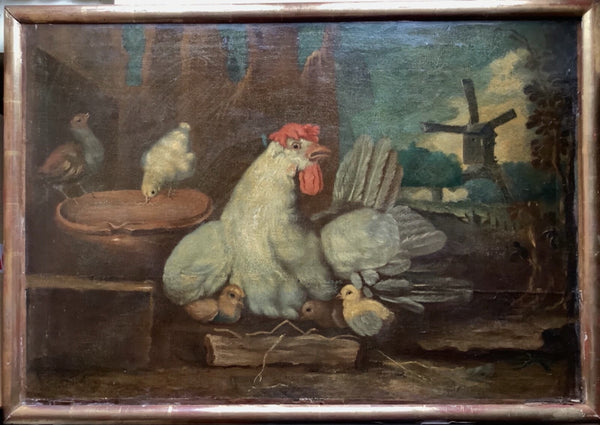
Hung, horizontal, 38 inches framedThe width a mantel was made forThirty-eight inches across a standard French mantel, hung with a hand's breadth of clearance. The picture follows the line of the shelf rather than fighting it, which is why horizontal antique landscapes and barnyard scenes have always been the natural choice for this wall. |
![]() |
Hung, vertical, 21 inches framedRising instead of spreadingTwenty inches across is narrow for a mantel, so the composition earns its place by height and the chimney breast has to carry it. This wants a room with ceiling, and a shelf left clear apart from a pair of candlesticks. |
![]() |
Standing, 22 inches framedOn the shelf, not above itAt twenty-two inches this would look lost on a broad chimney breast, and it is better for standing. Placed between two candelabra and lit from the side it reads at close range as a hung picture never does. Nothing is fixed to the wall, and it moves in a moment. |
![]() |
Beside, 14 inches framedWhen the trumeau has already wonTwelve inches across is too small for any mantel, and here the question does not arise because the chimney breast carries a mirror. The panel takes the wall beside instead, at eye level, where a cabinet picture is read at the distance it was painted for. |
| Four pictures, one fireplace, and only one of them belongs on the wall above it. | |
Room settings are photographic compositions made from the paintings themselves.
The honest answer
Heat, Smoke and an Old Canvas |
The question is a fair one, and it is the first thing an experienced buyer asks. A working fireplace produces heat and, with an open flue, a certain amount of smoke, and neither is good for a nineteenth-century canvas or its varnish.
In practice a modern insert or a closed hearth throws little heat upward, and the shelf deflects most of what rises. The risk is real with an open fire burned often, and it is cumulative rather than sudden. An antique painting hung above an open hearth in daily winter use will need cleaning sooner than one on any other wall in the house.
Two precautions cost nothing. Leave the clearance rather than tucking the frame against the shelf, so warm air can pass behind it. And take the picture down for the season if the fire is lit every evening, which is also the moment to look at the back of it and at the state of the varnish.
Five subjects, ranked
Which Antique Paintings Suit a Fireplace |
Swipe →
| Landscape | The safest choice for a fireplace, and the oldest. A horizontal antique landscape matches the line of the shelf, the depth carries at a distance, and a pale sky lifts a wall that is usually the darkest in the room. | |
| Animal and sporting | Made for this wall in the English and French country house, and they still belong there. A hound or a hunting scene reads well in a room where people sit and talk. | |
| Old Master figures | A figure group asks to be read rather than glanced at, which suits a room where people sit. Darker than a landscape, so it wants a picture light or a lamp nearby. | |
| Portrait | A single face above a fireplace is a strong statement. It works in a hall or a study, and it can dominate a sitting room in a way a landscape never does. A decision, not a default. | |
| Still life | Rarely works here. The scale is intimate, the reading distance short, and the subject asks for a dining room or a kitchen wall instead. |
Six checks before you order
Buying an Antique Painting for Above the Fireplace |
Measure the mantel first. Two thirds to three quarters of that width, framed. Nothing else matters until you have that number.
Read the framed dimension, not the canvas. A period gilt frame adds four to eight inches across. Both figures are on every listing here.
Prefer a horizontal antique painting for a standard mantel. The format follows the line of the shelf. Vertical works when the chimney breast is tall and the mantel narrow.
Account for the objects. Candlesticks, a clock and a pair of vases will take the clearance you were counting on.
Consider the light. A fireplace wall is often the darkest in the room. A picture with a pale sky or a bright passage will read where a very dark canvas will not, unless you light it.
Look at the frame as much as the picture. A gilded moulding catches firelight and candlelight in a way a plain one does not, and above a fireplace that matters more than anywhere else in the house.
| → | The next questionWhere do most of the landscapes that suit this wall come from?The Barbizon School and the generation that followed, who made the horizontal landscape a French speciality. |