Cals, Adolphe Felix (1810–1880)
Search the collection for this artist →
Related biographies: Peraire, Paul Emmanuel (1829–1893) · Desvarreux-Larpenteur, James (1847–1937)
Browse the collection: French artists · Landscape paintings · 19th-century paintings
Biography
Early life
Adolphe Felix Cals occupies a place in art history that very few painters can claim: he exhibited in the first Impressionist exhibition of 1874, alongside Monet, Degas, Renoir and Pissarro, and he was the oldest artist in the room. Born a full generation before the Impressionists, he arrived at their door by his own path, and some historians have come to regard him as one of the true precursors of the movement, the missing link between Corot and Impressionism.
He was born in Paris on 17 October 1810, into a modest working-class family. A frail child, he was apprenticed young to the engraver Jean-Louis Anselin, and after Anselin's death in 1823 continued his training under Nicolas Ponce and then Jean Bosq, who taught him burin engraving. In 1828 he turned to painting and entered the studio of Leon Cogniet, a neoclassical master with little sympathy for the loose, honest manner his pupil was developing. The relationship was tense and short. Cals left, and from then on he answered to no school but his own eye.
The Salon, the Refuses, and pere Martin
From 1835 Cals exhibited portraits and landscapes at the Salon, quietly and without official honours, painting the subjects that would occupy him all his life: humble people, peasant interiors, scenes of everyday and family life. In his choice of subjects he prefigured Millet. In 1863 he showed at the famous Salon des Refuses, in the company of Monet, Degas and Pissarro, the generation whose battles he would later share.
Two encounters changed his fortunes. The picture dealer Pierre-Firmin Martin, the legendary "pere Martin" who championed Jongkind and the young Impressionists, took up his work, and Cals painted portraits of Martin and his wife that now hang in the musee Eugene Boudin in Honfleur. Through Martin he met the comte Armand Doria, who became his first great patron and welcomed him at the chateau d'Orrouy in the Oise, where Cals painted the countryside of the Valois.
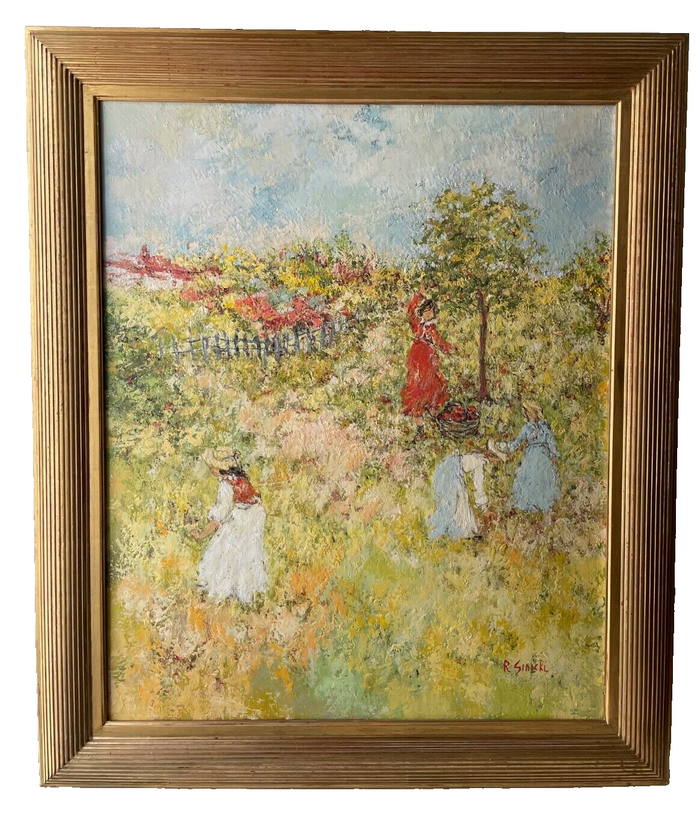
Adolphe Felix Cals, Haystacks Landscape, signed oil on canvas, 19th century. GalerieClub Fine Art.
Honfleur and the Saint-Simeon circle
Influenced by Corot and by his close friend Johan Barthold Jongkind, Cals worked in grey, broken tones, restoring light through small silvery touches, like dew on the surface of things. From 1871 he divided his life between Paris and Honfleur, and in 1873 settled for good in the Norman port with his daughter Marie. There he joined the circle of painters around the Saint-Simeon farm, the famous inn of mere Toutain where Boudin, Jongkind and the young Monet had forged the plein-air painting of the Normandy coast. Cals painted the farm itself, the port, the sea, and above all the people who worked it: fishermen, sailors' families, a grave, strong and deeply human painting.
With the Impressionists
At Monet's invitation, Cals took part in the first exhibition of the Impressionist group in April 1874, at the age of sixty-three. He returned for the group's exhibitions of 1876, 1877 and 1879, one of the very few artists of his generation to stand with the young movement from the beginning, and the group honoured his memory at their 1881 exhibition after his death. His Dejeuner a Honfleur of 1875 now hangs in the musee d'Orsay, and Le Pecheur of 1874, shown at that first exhibition, is in the musee Eugene Boudin in Honfleur.
Cals died in Honfleur on 3 October 1880, two weeks short of his seventieth birthday, having never stopped painting outdoors. Twenty years later the critic Arsene Alexandre devoted a full biography to him with a title that says everything about the man: A.-F. Cals ou le bonheur de peindre, "Cals, or the happiness of painting".
Legacy
For decades Cals remained one of the forgotten names of the first Impressionist exhibition, overshadowed by the celebrities of the movement he helped to launch. That is changing. Museum holdings at the musee d'Orsay and the musee Eugene Boudin, the patronage history with the comte Doria, and his documented presence in four of the group's exhibitions give him a historical weight out of proportion to his prices, which remain a fraction of those commanded by his younger colleagues. For collectors, a signed Cals is an authentic piece of the Impressionist story itself. We discuss his place among the acquirable Impressionists in our guide to French Impressionist landscape painting beyond the famous names. Every work offered by GalerieClub Fine Art ships free to the United States and Canada.
Timeline
1810 Born 17 October in Paris, into a modest working-class family.
1823–1828 Trains as an engraver under Jean-Louis Anselin, Nicolas Ponce and Jean Bosq, then enters the painting studio of Leon Cogniet, which he soon leaves.
1835 Begins exhibiting portraits and landscapes at the Paris Salon.
1863 Exhibits at the Salon des Refuses alongside Monet, Degas and Pissarro. The dealer pere Martin introduces him to the comte Armand Doria, his first major patron.
1871 Begins dividing his life between Paris and Honfleur.
1873 Settles permanently in Honfleur with his daughter Marie and joins the painters of the Saint-Simeon farm.
1874 At Monet's invitation, exhibits in the first Impressionist exhibition, the oldest artist of the group. Le Pecheur, shown there, is now in the musee Eugene Boudin.
1875 Paints Le Dejeuner a Honfleur, now in the musee d'Orsay.
1876–1879 Takes part in the Impressionist exhibitions of 1876, 1877 and 1879.
1880 Dies in Honfleur on 3 October, aged 69. The Impressionists pay tribute to him at their 1881 exhibition.
1900 Arsene Alexandre publishes the biography A.-F. Cals ou le bonheur de peindre.