
Skip to content

Cart

Your cart is empty

Article: Collecting Antique Dog Portraits

Collecting Antique Dog Portraits

Collecting Antique Dog Portraits

To view our collection of animal paintings
Part of our series on animal painting in our Collecting Guides. See also our guide to Animal Painting in 19th-Century France and our practical guide to Understanding Condition.

Of all the categories of antique painting, none is bought with more feeling than the dog portrait. People buy landscapes for the wall and dogs for the heart, and the market has known this for three hundred years. Louis XV commissioned Jean-Baptiste Oudry to paint his favorite hunting dogs by name; Queen Victoria's devotion to her dogs, painted by Edwin Landseer, made the dog portrait a fixture of the 19th-century home; and every prosperous family that followed wanted its own companion recorded in oil. What survives is a large, warm, and still affordable field, and one of the few where collectors routinely search by breed.

A Short History of the Painted Dog

Dogs appear in European painting from the beginning, as symbols of fidelity in portraits and as workers in hunt scenes. The dedicated dog portrait, the dog as the whole subject, emerges in the 18th century with court painters like Oudry in France, and becomes a full genre in the 19th. Two forces drove it: the rise of the bourgeois household, which adopted the aristocracy's habit of commemorating companions, and the codification of breeds, which the Victorian era pursued with taxonomic passion. By 1900, painters across France, England and Belgium made steady livings painting other people's dogs, and animal painting had its own Salon specialists and its own collectors.

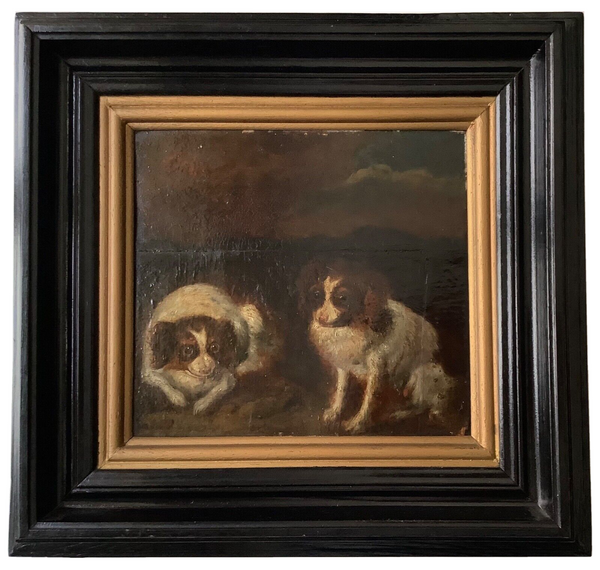
Circle of Alexandre Francois Desportes, portrait of two King Charles Spaniels, 17th century oil on panel, framed

From our collection: Circle of Alexandre François Desportes, Two King Charles Spaniels, 17th Century

The court tradition itself: two King Charles Spaniels painted on panel in the circle of Desportes, the animal painter of Louis XIV's court and Oudry's great predecessor. A dog portrait of this age is a genuine Old Master rarity, from the very decades when the genre was being invented at Versailles.

View this painting

What Makes a Good Dog Portrait

The eyes, above all. Exactly as with human portraiture, the test of the painter is presence: does the animal look back? A competent painter renders fur; a good one renders attention, character, the particular way this dog held its head. That is what the original owner paid for.

Individuality over type. The best dog portraits depict a specific animal, not a breed illustration. Look for asymmetries, an honest posture, sometimes a painted name or collar detail: signs the painter worked from a real, known dog.

Painterly quality in the fur. Rendering coat convincingly, dense, layered, catching light, is genuinely hard. Stand close and judge the brushwork as you would any painting.

Charles Joshua Chaplin, portrait of a Labrador puppy, signed and dated 1882, oil on mahogany panel, framed

From our collection: Charles Joshua Chaplin, Portrait of a Labrador Puppy, Signed and Dated 1882

A signed and dated work by Charles Joshua Chaplin (1825-1891), a celebrated Salon painter best known for his elegant portraits of women, here turning his refined touch to a Labrador puppy on a mahogany panel. When a society portraitist paints a dog, it is usually because a client loved that dog very much.

View this painting

Ernest Jean Delahaye, portrait of a Pekingese dog named Kit, signed oil on panel, late 19th century, framed

From our collection: Ernest Jean Delahaye, Portrait of a Pekingese Dog "Kit", Signed

A signed late 19th-century portrait by Ernest Jean Delahaye (1855-1921) of a Pekingese named Kit. The recorded name is exactly the detail collectors of this genre treasure: this was a real dog, loved enough to be painted and remembered by name.

View this painting

Gaston Simoes de Fonseca, portrait of a dog named Pipo, signed gouache on paper, early 20th century, framed

From our collection: Gaston Simões de Fonseca, Portrait of a Dog "Pipo", Signed

Kit has company: an early 20th-century signed gouache by Gaston Simões de Fonseca (1874-1943) of a dog named Pipo. Two named dogs in one collection is no coincidence; recording the name was part of the commission, and it is why these portraits still feel personal a century later. The gouache medium, quicker and more intimate than oil, suits the affection of the subject.

View this painting

Collecting by Breed

Dog paintings are one of the rare fields where the market organizes itself by breed. Collectors who own or love a breed hunt for its historical portraits, and breed clubs and their members form a durable base of demand. Sporting breeds, spaniels, setters, pointers, retrievers, dominate the surviving material because of the hunting tradition; toy and companion breeds, from Pekingese to poodles, carry the charm of the salon. A wrinkle worth knowing: breeds changed. A Labrador or a Pekingese painted in the 1880s does not look exactly like today's standard, and for enthusiasts of breed history that difference is a feature, not a flaw, since period paintings are primary documents of what the breed once was.

Portrait of Samoyed dogs, 19th century French School oil on canvas, framed

From our collection: Portrait of Samoyed Dogs, French School, 19th Century

A French School canvas of Samoyeds, their white coats a bravura exercise in painting light on fur. Unsigned, as much honest 19th-century work is, and judged, as it should be, on the quality of the painting itself.

View this painting

The Dog Beside the Owner

Not every great dog picture is a solo portrait. The dog-and-owner composition, gentleman with his pointer, hunter with his hound, runs deep in the tradition and often tells the richer story: the bond itself is the subject.

Charles Suan, gentleman in a landscape with his dog, signed French Romantic oil on canvas, 1839, framed

From our collection: Charles Suan, Gentleman in a Landscape with His Dog, Signed, 1839

A signed French Romantic canvas of 1839: a gentleman and his dog together in the landscape, painted as a pair in every sense. Suan painted a companion piece, a hunter with his dog, the same year, and the two works together show how central the dog was to the image a 19th-century man wanted of himself.

View this painting

Practical Notes for the Field

Signatures matter here. The 19th-century animal painters were professionals with careers and auction records; a signed and dated work, like the Chaplin above, anchors value. Our signatures guide covers how to read them.

Condition follows the usual rules. Relining and honest craquelure are normal in canvases of this age; what matters is that the head, the face of the portrait, reads well. See our condition guide.

Small formats are the genre's charm. Many dog portraits were painted on panel or small canvas for intimate rooms, which makes them among the easiest antique paintings to live with today: a hallway, a study, a landing beside the leash hooks.

Browse Our Animal Paintings

Read More in This Series

Continue with Animal Painting in 19th-Century France, or explore our full Collecting Guides.

Read more

How to Read Signatures and Inscriptions on Antique Paintings
Buying advice

How to Read Signatures and Inscriptions on Antique Paintings

A signature is a clue, not a verdict. Where to look, how to read monograms and dates, and the red flags that separate real signatures from added ones.

Read more
Animal Painting in 19th-Century France
Animal cluster

Animal Painting in 19th-Century France

Delacroix's tigers, Bonheur's herds, the hunt and the farmyard: how France made animal painting a serious genre, and where the value sits today.

Read more