
Peraire, Paul Emmanuel (1829–1893)
Search the collection for this artist →
Related biographies: Cals, Adolphe Felix (1810–1880) · Desvarreux-Larpenteur, James (1847–1937)
Browse the collection: French artists · Landscape paintings · 19th-century paintings
Biography
Early life
Paul Emmanuel Peraire, sometimes written Péraire, was a French landscape painter of the Barbizon school whose lifelong subject was the water and light of the rivers around Paris: the Seine at Saint-Denis, the banks of the Oise, the mills of the Andelys, ponds catching a pale morning sky. He came to painting late, after a first career in finance, and once he did, he never left it. He exhibited at the Salon every year from 1866 until his death.
He was born in Bordeaux on 12 September 1829, into a family of stockbrokers of Portuguese Jewish origin. His grandfather Abraham had settled in the city after the revolution in Saint-Domingue, and his father David Peraire practised the family trade of agent de change. Paul was expected to follow, and for years he did, working in the financial world while the great landscape revolution of Corot, Daubigny and the Barbizon painters unfolded around him.
From the Bourse to painting
His life changed direction in 1859, when he was caught up in the affair of the coulissiers, the unofficial curb brokers who traded outside the regulated Paris Bourse and who were prosecuted that year. Convicted in the case, Peraire left finance entirely and devoted himself to the one thing he had always wanted to do: paint.
He trained under two well-established masters, Eugène Isabey, the great Romantic painter of coasts and harbours, and Évariste Vital Luminais, and made his Salon debut in 1866 with a river subject, L'Île de Croissy à Bougival. He was then thirty-six years old. By that date he had already settled in Montmartre, where he had married Marie Jeanne Hortense Bailleul in 1857 and where the couple raised three children.
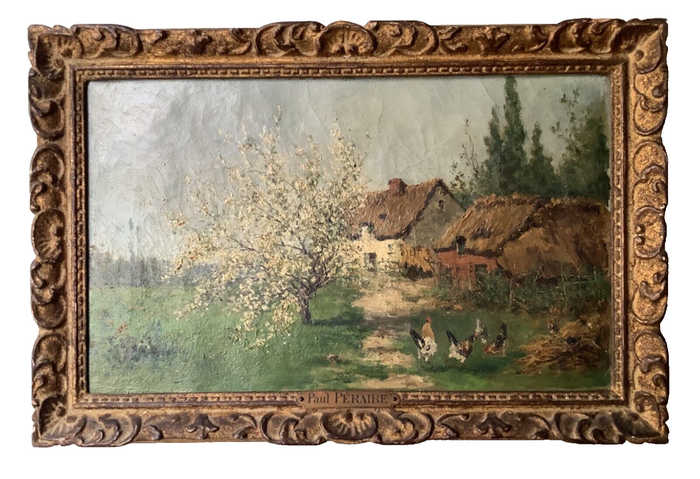
Paul Emmanuel Peraire, Farm Landscape in Spring, signed oil on canvas, 19th century. GalerieClub Fine Art.
A Salon career built on rivers
From 1866 onward, Peraire showed at the Salon des artistes français every single year until his death, a run of more than a quarter of a century. His submissions read like a map of the waterways of the Île-de-France and Normandy: Sur la butte Montmartre and La villa au père Macou à Bondy in 1875, La Seine à Saint-Denis in 1880, Terrains blancs à Saint-Ouen in 1885, L'Étang du grand veneur in 1889.
Official recognition followed. In 1879 the French State purchased Le Moulin des Andelys directly from the Salon, and the painting was deposited at the musée des beaux-arts de Bordeaux, the museum of his native city. In 1880 he received a third-class medal at the Salon for La Seine à Saint-Denis. In 1882 he represented French landscape painting abroad, showing L'Étang à Mortefontaine at the international exhibition in Vienna, and the same year exhibited La Saison dorée at the Salon des arts décoratifs in Paris.
Style and manner
Peraire's early Salon canvases were large and classically finished, in the polished manner juries expected. As he matured, his touch thickened, his palette grew deeper and more tonal, and he turned increasingly to smaller formats painted on wood panel. It is in these later panels that his true affinities show: the silvery river light of Corot, and above all the broad, moist handling of Charles-François Daubigny, the Barbizon painter he most closely recalls. Like Daubigny, Peraire understood that a river bank at dusk, a fisherman in a flat-bottomed boat, a line of willows doubled in still water, needed no anecdote to carry a picture.
His works are typically signed "P. Peraire" in a lower corner. Subjects to look for include the Seine, the Oise and the Marne, the countryside around Montmartre and Saint-Denis before the city swallowed it, Normandy coasts and, in his later years, farm and pond scenes handled with a freedom that borders on the pre-Impressionist.
Paul Emmanuel Péraire, Un coup de vent, 1892. Musée Salies, Bagnères-de-Bigorre. Image: Wikimedia Commons.
Later years
Peraire spent his whole painting life in Montmartre, at 46 rue Lepic, in the years when the Butte was still half village and half city, the very slopes he had painted at the Salon of 1875. He exhibited one last time in 1892, the year he completed Un coup de vent, now in the musée Salies at Bagnères-de-Bigorre, and died at home on 21 January 1893, aged 63. His studio sale was held at the hôtel Drouot in Paris shortly afterwards; the rue Lepic studio itself was later taken over by the Fauve painter Charles Camoin, a small footnote that links this quiet Barbizon painter to the generation that came after.
Legacy
Peraire belongs to the solid second rank of the Barbizon school, the painters who carried the manner of Corot and Daubigny through the last decades of the nineteenth century with complete conviction. His paintings are held in French public collections, including the musée des beaux-arts de Bordeaux and the musée Salies in Bagnères-de-Bigorre, and he is recorded in the artist repertories of the musée d'Orsay and the Louvre's department of graphic arts.
On the market, his work appears regularly at auction in France, Germany and the United States, with over a hundred recorded results in international databases, a sign of a steady, liquid market for a listed artist. For collectors in the United States and Canada, a signed Peraire brings home the authentic Barbizon river landscape, painted by a man who gave up the Bourse for the banks of the Seine and never looked back. Every work offered by GalerieClub Fine Art is delivered with free fine-art shipping to both countries.
Timeline
1829 Born 12 September in Bordeaux, into a family of stockbrokers of Portuguese Jewish origin.
1857 Marries Marie Jeanne Hortense Bailleul in Montmartre; the couple will have three children.
1859 Convicted in the affair of the coulissiers, the unofficial curb brokers of the Paris Bourse. Leaves finance and turns entirely to painting. Trains under Eugène Isabey and Évariste Vital Luminais.
1866 Salon debut with L'Île de Croissy à Bougival. Begins an unbroken annual run at the Salon des artistes français that lasts until his death.
1875 Exhibits two Montmartre and Bondy subjects at the Salon, painted around his own neighbourhood.
1879 Le Moulin des Andelys purchased by the French State at the Salon and deposited at the musée des beaux-arts de Bordeaux.
1880 Third-class medal at the Salon for La Seine à Saint-Denis.
1882 Shows L'Étang à Mortefontaine at the international exhibition in Vienna and La Saison dorée at the Salon des arts décoratifs in Paris.
1885–1889 Continues to exhibit river and pond landscapes at the Salon, including Terrains blancs à Saint-Ouen and L'Étang du grand veneur.
1892 Final Salon appearance. Paints Un coup de vent, now in the musée Salies, Bagnères-de-Bigorre.
1893 Dies 21 January at his home and studio, 46 rue Lepic, Montmartre, aged 63. Studio sale at the hôtel Drouot. The studio is later occupied by Charles Camoin.