

Home›Painters & Their Masters›Émile Michel
Biography · French School
Émile Michel
1828 to 1909
Émile Michel was a landscape painter from Metz and one of the leading French scholars of Rembrandt. He showed at the Paris Salon for fifty-five years, left his native city when it became German, and was elected to the Académie des Beaux-Arts in 1892.

Original Émile Michel Paintings for Sale
Signed E. Michel lower left, with a long underline and often a two-figure date

Other painters of the same school.
 Adolphe Félix CalsHaystacks in a Stubble Field
$8,900See the painting
Adolphe Félix CalsHaystacks in a Stubble Field
$8,900See the painting
 James Desvarreux-LarpenteurOxen and Sheep in a Clearing
$3,700See the painting
James Desvarreux-LarpenteurOxen and Sheep in a Clearing
$3,700See the painting
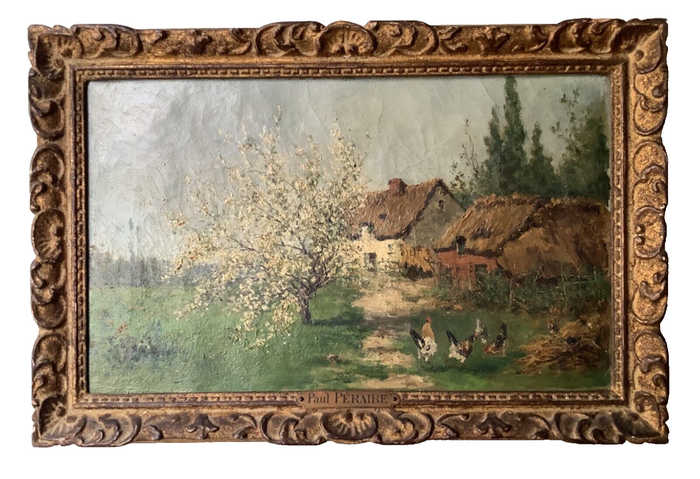 Paul Emmanuel PeraireBlossoming Tree and Farmyard
$3,700See the painting
Paul Emmanuel PeraireBlossoming Tree and Farmyard
$3,700See the painting
 Charles Edmond RenaultWoman and Child by the Water, 1800s
$3,600See the painting
Charles Edmond RenaultWoman and Child by the Water, 1800s
$3,600See the painting

A Landscape Painter's Field
The figure is small. The oaks take half the canvas.
His subjects are the landscape with figures and the rural working scene, in the naturalist manner that runs from Barbizon into the second half of the century. The landscape usually takes the larger share of the canvas, and the figures are kept small against it.
Who Trained Émile Michel
He trained at Metz under Auguste Migette, in the circle of painters known as the School of Metz, who painted their own region, its light and its weather.
His teacher
The painter
Other teachers
- Laurent-Charles Maréchalstained-glass painter of Metz
From Metz to the Académie
Born and trained at Metz, he left for Nancy when the city became German, and ended his life a member of the Institut de France.
- 1828Born at Metzon 19 July
- 1853First Salonhe would show until 1908
- 1872Leaves Metz for Nancyafter the annexation
- 1892Académie des Beaux-Artselected
- 1909Dies in Parison 23 May
Stories about Michel
1 of 2
The choice of 1872.
In 1871 the treaty that ended the Franco-Prussian war gave Metz to Germany, and its people had to choose between keeping French nationality and leaving, or staying as German subjects. In 1872 Michel left the city where he was born and trained, and settled at Nancy on the French side of the new border. The painting in the gallery is dated that same year.

GalerieClub Fine Art
1,100+
paintings sold since 2017
Our promise
- Every painting photographed front and back
- The frame you see is the frame that ships
- Free tracked UPS Express Saver to the US

Biographical information compiled from published French reference sources and museum records. Photographs of the painting by GalerieClub Fine Art.