

17th century
Dutch Golden Age & the Dutch School
The Dutch Golden Age was the extraordinary flowering of painting in the seventeenth-century Dutch Republic, when artists worked for an open market of ordinary citizens rather than for court or church.
Schools of the 1600s
Dutch School Paintings in Our Collection
 Hen and Chicks, circa 1700
More from this school
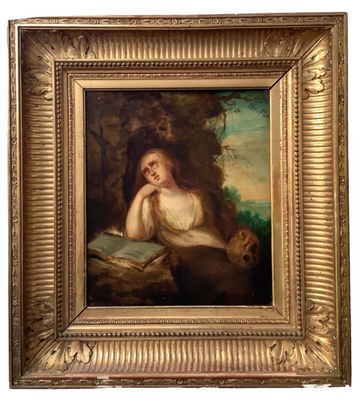

What the copying of a famous composition actually was, and what a canvas made that way is, is set out in our guide to period copies after the Old Masters.
- 1602 The trading age opens
- 1632 Rembrandt settles in Amsterdam
Painting for the Merchant
The Dutch Republic of the seventeenth century was Protestant, mercantile and without a royal court. Painters therefore worked for an open market of merchants, burghers and craftsmen who bought pictures for their homes. This changed everything. Instead of altarpieces and dynastic portraits, artists specialised in the subjects their customers wanted, and produced them in volume.
- 1642 The Night Watch
- 1660s Vermeer's great interiors
A Republic of Specialists
Rembrandt van Rijn gave the portrait a psychological depth no one had reached before, and Johannes Vermeer turned the domestic interior into a study of light itself. Around them, whole careers were built on a single genre. Jan van Goyen and Jacob van Ruisdael in landscape, Willem Kalf and Willem Claesz Heda in still life, Jan Steen in the merry company, Paulus Potter in cattle. Genre painting, landscape and still life all became major subjects in their own right, which had never been true anywhere before.
- 1672 France invades the Republic
- 1700s The Dutch manner lives on
The Manner Outlives the Republic
The Year of Disaster in 1672, when France invaded the Republic, broke the art market and the great generation dispersed. But the Dutch manner had become a European language. Its subjects and its handling were imitated across the continent for two centuries. The floral still life in particular, invented in Holland, became a standard of European painting well into the nineteenth century, painted in France, Belgium and Britain in a manner that remained recognisably Dutch.
Three of the thirty-six known Vermeers hang in a single New York house.
Henry Clay Frick bought them between 1901 and 1919, and they still hang in his New York house, now the Frick Collection. Twelve of the thirty-six, a third of his known paintings, are in American public collections today.

GalerieClub Fine Art
1,100+
paintings sold since 2017
Our promise
- Every painting photographed front and back
- The frame you see is the frame that ships
- Free tracked UPS Express Saver to the US


